The
History of the Runestaff by Micheal Moorcock contains four novels
The Jewel In The Skull,
The Mad God's Amulet,
The Sword Of The Dawn, and
The Runestaff.
I found reading though the books a bit of a slog, not that Moorcocks writing is challenging or the ideas were particularly less interesting than his other works, but the protagonist Dorian Hawkmoon of Koln is somewhat dull. Unlike the tortured, disfigured and somewhat reluctant incarnations of the Eternal Champion - Elric of Melniboné and Corum Jhaelen Irse, Hawkmoon is hero cast in the more traditional mould of Swords & Sorcery hero - a natural leader, a military man, determined, proud and valiant. While he is as much a pawn of higher powers beyond his comprehension as the others, he takes his fate with aplomb - he's also more human, rather than the elvish Vadhagh or Melnibonéan.
 |
| Jim Cawthorn : Map of the Dark Empire |
Then there's Hawkmoons world, which for all intents and puropses is a post-post-apocalyptic Earth, with clear references to real world place names, and people - notably figures from the pre-catastrophy 1960s such as The Beatles and Harold Wilson. These references are just an incidental gloss rather than being used for amusing the or satirical effect. I found it slightly grating and lacking the spark of sardonic wit and psychedelic verve that accompanies Moorcocks other stories, but then I've never liked The Beatles. Maybe living in a post-truth, post-brexit, economically and culturally insecure Britain of the 21st century, the idea of the island of Granbretan (Great Britain) invading and unifying mainland Europe by force with legions of animal masked warriors fails to resonate all that much. Yet.
 |
| Jim Cawthorn : The Emperor |
Moorcocks reflects on the writing of Hawkmoon in an article at
tor.com - British nationalism and anti-German sentiment of the Britain in the 1960s (especially from the editors of pulp fiction and war comics he was writing for) and Hawkmoon as a construction of a German saving a small French dominion (and then subsequently the entire world) from an evil British Empire, being a direct overturning of the conservative values and an intentionally countercultural move. Some attitudes may have changed since then, but it doesn't feel revolutionary, small minded nationalism is still the province of the hysterical far-right rather than an ingrained status-quo.
There certainly are high-points of effective prose - pirate cultists carrying out a grisley ritual, and Hawkmoons summoning a legion of undead legion of southern barbarians using his Sword of the Dawn is evoked with a deftness and weirdness that is striking. Other encounters with the weird, such as the ghostly elfin inhabitants of ancient cities aren't quite as successful, and seem a little out of place in an otherwise earth-bound fantasy sequence. The walls of the multiverse grow thin and stranger things step across the dimensions.
 |
| Jim Cawthorn : The Palace of Taragon |
The characters are very sketchily outlined, and although we see Dorian fall in love and embark upon an epic quest we don't really know much of Hawkmoons internal life. The question of Hawkmoons falling in love with the daughter of the ruler of Karmag, and his pledging allegiance to the nation feels very much in the vein of a fairytale allegory of political allegiances. The Nation as female - we can think of Marianne of the French Republic, Britannia of Great Britain, Helvetia of Switzerland or countless other examples. The female relegated to a position of passivity, a prize to be fought over and won, a symbol equated with nation-state, rather than as a self-motivated individual, almost Arthurian in its romantic conservatism, the characters become near-allegorical symbols with very little internal motivation.
The big-bad-end-guy is the immortal King-Emperor Huon, an immortal being, entrapped in his Globe Throne, served by bickering political factions. Huon is eventually usurped by his second in command, a revolution that Hawkmoon uses to finally defeat his enemy despite serious losses of friends.
 |
| Jim Cawothorn : Jewel in the Skull |
The edition I have contains some panels from the collaboration / adaptation with Jim Cawthorn on the Hawkmoon books. Jims work is stunning. I'm sure that if Cawthorn had led my introduction to Hawkmoon through the comics first, I'd feel much more positively about it. Also the physical format of the collected book. The combined volume feels like one of those door-stop blocks of fantasy epic, and it doesn't really do Hawkmoons lightweight characterisation and gung-ho satire world justice. With the original four slim paperbacks, the episodic and pulpy nature somewhat spelled out by the material presence of the book. I might slice up my
Elric of Melinboné before embarking upon re-reading it to see if there is any merit in this consideration.
Under the Nefarious Influence of the Dark Empire
The second edition of
Warhammer Fantasy Battle was dedicated to Moorcock, Tolkien and Phil Barker. The influence of Moorcock in early Warhammer is everywhere, from incidental art clearly depicting Elric to the eternal struggle of Chaos and Law and back again.
There are specific motifs that stem from the Hawkmoonian milleu - the use of real-world geographical cues being a fundamental one, as are the punning references to contemporary pop-culture and political figures, which abound in early Warhammer. The entire 'expected to be good guys are actually bad guys' trope of the Empire in 40k reflected in Gran Bretan except Moorcock has the decency to have actual good guys who fight oppression, so the whole universe doesn't descend into the hate-thy-neighbour fascist philosophy like 40k does.
The story of the King-Emperor being usurped by his most powerful and at one point trusted warlord is one that resonates down to ancient times, but it's also clear precursor of The Horus Heresy. The thematic legions such as Meliadus' Order of the Wolf are echoed in the Space Wolf Chapter of the Space Marines. The insane gothic splendour of Londra reflected in a billion Imperial buildings.
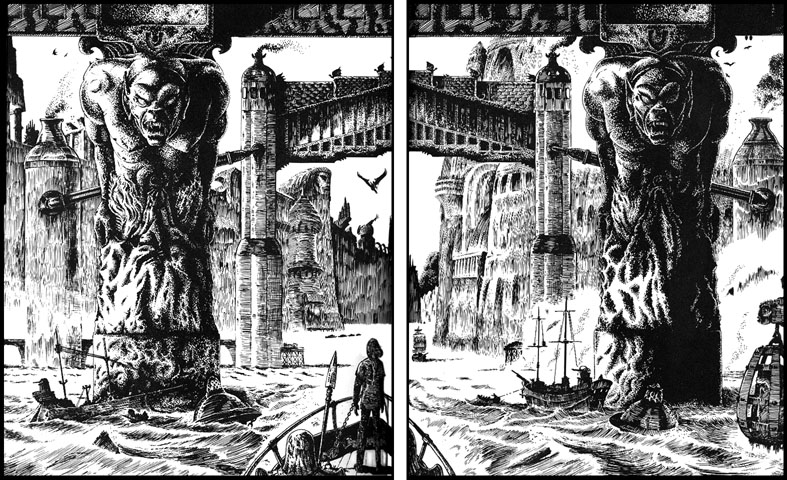 |
| Jim Cawthorn : The Bridges of Londra |
The battle as depicted in
The Runestaff feels very wargamey, the narrator often taking a high vantage point as the battle spills out across the docks of Londra and to the Palace of Huon, and even talks about weapons having minimum ranges, very gamey. The climactic fight through the streets is quite tense. The Siege of Kamarg (in
Jewel in the Skull IIRC) also features ornithopters (which appear in
40K:RT) which fly over great energy heavy-weapons mounted on castle towers that burn great swathes through massed troops. This mixture of medieval fantasy and lost high technologies permeates throughout.
The Lost Chronicles of Mournblade
At one point GW speculated on developing a Warhammer supplement based on the Elric Saga, so why not other incarnations of the Eternal Champion? Most of the characters and troops would be standard human / hero / major hero profiles, with only their arms, armour and techno-sorcerous equipment to really differentiate them. So here follows some musing and rules on the weaponry in Hawkmoons world at the time of the Dark Empire:
The Flame Lance
The First Citadel Compendium (1983) gives stats for The Flame Lance - an energy weapon that appears in History of the Runestaff, wielded by the goodly legions of Kamarg under the command of the mighty Count Brass.
 |
| Flame Lance - Citadel Compendium |
The firing, discharge and re-energising cycle is pretty spot on for the Flame Lance of Hawkmoon. It isn't quite a laser weapon - having features of both laser and fire weapon, but it's a reasonable write up that hews closely to the text. People often talk about Moorcocks influence on
Warhammer in a vague or loose sense -chaos, critical self-awareness of genre - but this is a straight-forward adaptation, showing I think the impact and importance of Moorcocks works and Warhammer being specifically designed to translate those stories into games.
 |
Eternal Champion: Citadel Journal (1986) Hawkmoon Bottom Right
Designed by Jes Goodwin, painted by John Blanche |
Jes even included what looks like a Flamelance on his figure of Hawkmoon for Citadels B
C5 Eternal Champion Boxed Set (photo, bottom right). Hawkmoon doesn't wield one in
The History of the Runestaff series, does in the contnuation
Count Brass. Either way it's an iconic weapon from the stories that certainly deserves representation. The Citadel Journal article gives the flamelance the following stats:
Flamelance: SR: 12" LR: 30" 1D6 S6 hits. 3 turns to reload.
The elongated flame weapon concept would continue into 40ks Eldar energy weapon / polearm hybrid weapons - notably the Fire Pike of the Fire Dragon Exarch,
Flame-Lance,
Fire-Pike.
 |
| Eldar Fire Dragon Exarch with FirePike | via |
It's not too difficult to re-imagine Jes Goodwins Eldar design as a organic-armoured Karmagian soldier
in the style of Rodney Matthews. The Rogue Trader version of the Firepike / Flame Lance is described as the Ancient Eldar weapon in the Eldar supplement of White Dwarf #127 (reprinted in the Rogue Trader Compilation):
It's slightly more powerful than both the 1st Edition Warhammer and 2nd Edition versions above, and if the 3 shots a day limit were re-instated, this would make a good statline for the Flame Lance.
So what of the other artefacts from Hawkmoons plane of the multiverse?
The Runestaff
A multidimensional artefact of immense power, the Runestaff appears as an ornate wooden pole, some 6ft tall, encrusted with shifting and ancient runes. Weird lights and patterns project out from the staff, making a dazzling psychedelic display in the air around the user. The Runestaff is a Battle Standard which weaves the strands of fate around its wielder, allowing the unit that carries it to re-roll any dice in combat, and cause Fear in chaotic units within 12" . 150PV
The Sword of the Dawn
For a skirmish-level and low points value games The Sword of the Dawn summons 1d6 Warriors of the Dawn. For a full-scale wargame, the forces summoned by the Sword should really be calculated in at the outset, but placed on the tabletop within 24" of the wielder. 200PV
Warriors of the Dawn
The warriors summoned by the Sword of the Dawn carry Spears and Shields, and have a standard human profile. However, when defeated in combat, a new Warrior of the Dawn appears next turn, within 12" of the bearer of the Sword of the Dawn, to a maximum of 3 regenerations.
The Amulet of the Gods
Lends strength and wellbeing to its wearer. +1 Strength +1 Toughness. 50PV
The Jewel in the Skull
The Jewel in the Skull is a piece of arcane technology developed by the Dark Empire of Granbretan to control Hawkmoon. Each turn, an opposing player
may attempt to activate the Jewel. Roll 1d6
1-2. The jewel remains inactive. No effect.
3. The victim is wracked with pain. Lose 1 W
4. Black-out. The victim may do nothing for 1d6 turns.
5. Complete mind control. The opposing player may decide actions of the character.
6. Full activation. The victim is dead.
Possession of the Runestaff will nullify the effects of the Jewel in the Skull.
Mirrorhelm
Again, the Eldar are described with something very similar - in this case the Harlequins Rictus Mask (
White Dwarf 106 / 40K Compilation). The mirrorhelms are worn in the final march against Granbretan by Hawkmoon and the other heroes. A strangely-wrought reflective helmet that replaces the attackers face with that of the victim. Causes Fear in hand-to-hand combat. 25PV
Funny, that whilst I'd consider these the weakest of Moorcocks stories I've read, the idea of gaming some of the conflicts using the characters and armaments seems really quite appealing.