Showing posts with label Radio Free Magnamund. Show all posts

Wednesday, 27 May 2015

8-bit Dungeonsynth BBC Micro

Another journey into the strange world of 8-bit Dungeonsynth this time the sonic delvers have unearthed arcane tracks from the cobwebbed catacombs of the abandoned BBC Micro software archive.

Perversely all tracks here are cover versions. By virtue of the dark sorcerous arts of programming in assembler code these otherwise otherwise innocous pieces of music have metamorphosed into something uncanny and unnerving.
 

The Stranglers "A Midnight Summer Dream" played by a melancholic android harpsicord atomaton. The D&D medieval fantasy imagery of Spellbinders endless twisted, turning corridors - each rendered in wonderful 1-bit colour,  summons Dungeonsynth vibes.


Franco-electronica  band Space's 1977 chart hit Magic Fly rendered on a Texas Instruments SN76489 sound chip by Byte the Apple is a cold, downbeat piece of atmospheric electonica, evoking vast cavernous tracts of frostbitten wilderness and melancholic tortured birdsong.


Yorkshires finest synthpop duo Fiat Lux scraped into the top-40 in 1983 with thier track Secrets. Byte the Apples cover version ventures into melodious spheres not usually associated with Dungeonsynth,  but creates an atmosphere of ghostly spirits crying in grey stone graveyards, pining for their lost souls. There's some grim bass sounds lurking in the sinister depths.

Update: Youtube Playlist Crypt of the Dungeonsynth

Friday, 4 July 2014

[RFM] Lone Wolf: Eclipse of the Kai [4/4]

Part 4: The Eclipse of the Kai


Zarganna mounted on a great Imperial Zlan beast, cicling high above the fray,  Arrows whizz past,  sword-clashes, distant shouting, the steady drums of war beating down. Actually the assault on the Kai Monastery works brilliantly, and is absolutely the best bit of the whole tape, a joy to listen to in all its gory detail.

It also helps if, whilst listening, you stare at this magnificent photo:

The Darklords Assault the Kai Monestary (from the Magnamund Companion and White Dwarf)

Along with the Maganmund Companion, this photo also appeared in White Dwarf 62 where no mention of the Kai Monastery is made, it does identify the fire-ball casting chap as the Chronicle Shaman (N12 Hobgoblin Shaman?). However it is noted as "playtesting Warhammer 2nd Edition" which seems a bit odd ...an actual playtest wargame would have bases, no? I suspect marketing shenanigans. Intriguingly the WD states that both this image and John Blanches WFB2 cover are available from Citadel as a poster - quick, to the Tardis Lucy!

The audio version of the battle places much more emphasis on the circling flying troops -  Zlann beasts, and no mention of the wolves evident in the diorama. Magnamundian mythology shifts over time, the tale grows in it's telling...

Alyss returns once again surrounded by warm synth strings with her seemingly infinite powers "but cannot interfere from history" (fixed points in time the plot and all that guff that comes with superpowered mary sue types... 'spoilers') and engages Vonotar in psionic combat. It's another example of how close to AD&D the Lone Wolf world really is.  Evoking synethesia, and the emotional draining of psionic blast. The scene starts off well, but veers off into realms of psychedelic mechanical insects, envoking Ian-Miller esque cyberinsectoid warfare, which dosn't really make all that much sense, and it drags on and on, only to smugly reveal that Alyss was simply delaying Vonotar's arrival at the battle to stop him from killing Silent Wolf.

psionic combat - it all gets a bit trippy | Ian Miller

As he nears the ill-fated Monastery with his message of doom Banedon realises he is to late, and hides amid in ancient ruin of temple stones in a forest and it dawns on me we've caught up with events in the gamebook... 
Banedon - Gary Chalk
 
Silent Wolf wakes up from a half-dream somehow hacked into by Alyss, and returns from slacking off from kitchen duties to view the bloody carnage and gruesome devastation of the Kai Monastery, before turning round and running off into the forest. Catching up with Banedon, and as the cassette spool runs out, finally takes for himself the name Lone Wolf...

Lone Wolf / ZXS Spectrum vsn / Gary Chalk

And there endeth he audiobook advenutres of Lone Wolf. Overall a highly enjoyable listen, some nice faux-medieval digital soundtracking by Joe Dever, some great delivery by Edward DeSouza, nice production values, but unfortunately some of the narrative that didn't work for me (anything regarding Alyss - too high-powered, too cliched).  Shame they didn't continue with the series really. I'm guessing it didn't sell too well, a cassette only release in the days of CD means the platform wasn't cool, and the at the very tail end of the gamebook boom (which itself was fueled by the D&D boom) probably meant it wasn't at quite the right time. A re-release these days on MP3 through digital channels, with the resurgence of digital gamebooks and the continuing expansion of the Lone Wolf brand through books, games (both tabletop and digital) etc. might prove popular. Until then, it can be dug up from Amazon or just don't forget to check the audio section of your local charity shop when hunting green spined books and the little lead men...

Tuesday, 17 June 2014

[RFM] Lone Wolf: Eclipse of the Kai [3/4]

Welcome to Radio Free Magamund, wherein I listen to stuff whilst doing other things, then write about it. Here we are listening to the third part of the audiobook of the novel of the gamebook adaptation of Lone Wolf Legends: Eclipse of the Kai, by Joe Dever and John Grant, read by Edward DeSouza.


Part 3: The Gathering Storm


Vonotar control of a gang of Giaks, and into the Dungeons of Kaarg.  Meeting the dark lord Zargana and blinded so he doesn't go mad looking at him. Zarganna has a kind of  Dalek voice modulator, which kinds of work. Vonotar and creates a hallucination of Zargana as a genial old man, offering tea  DeSouza voices him as a creakily well. Vonotar initiates himself into the evil Nadziranim magic through a weird psychosexual vampiric oedipal ritual with an old lady vampire. Freud and Crowley would approve.

Banedon stops for the night in a village, where his membership of the Brotherhood of the Crystal Star ensures him food and lodgings for the night. DeSouza does a fine west-country accent, for the peasantry (sterotyping of westcountry folk as kindly cider drinking yokels is ever apparant) and his female impersonation (of an old dear) is no where near as jarring as that of the youthful Alyss. It is the music, however that bears most notice - a medieval feel strongly reminicent of  Saltarello by Dead Can Dance from their 1990 album Aion (Aion/Aon - a coincidence surely?) Perhaps it's the specific medieval bagpipe instrument - undobtedly synthesised in the Lone Wolf soundtrack - this is a 'digital music sound track' after all and the jaunty rythem bubbles along nicely in the background and effectively conjours green fields and sackcloth...


Banedon leaves the village in the company of two children, in the direction of the Kai Monastry.

Back to Vonotar convinces to Zargana to  attack on the Eve of Midsummer, as all the Kai lords will be in one place, and so can be wiped out all at once and so unable to rally he armies of Sommerland against the Dark Lords. We arrive at the Kai Monastry - accompanied by a bombastic synth fanfare to find preperations for the Feast under way, and Silent Wolf on kitchen duties.

Struck by the theme of  hospitality which seems to run through this episode -
  • Banedons warm reception by peasants: one of rural, impoverished, domestic, familial,
  • Vonotars other strange, hallucinatory,  dungeonesque, manipulative and exotic, vampiric. power, 
  • Silent Wolf clumsy and inept preparations for the reception of guests at midsummer. 
It's perhaps interesting that the PC-character Silent Wolf takes the part of the host, albeit a minor role,  wheras both Banedon and Vonotar are guests. But it is the differences between these two magicians experiences that are the are the most striking, and the flipping between them seems to invite we consider the juxtaposition. The moral universe unfolds itself, and the kinds of experiences by the right (Vonotar) and left hand (Banedon) magicians paths manifest - domesticity being un-rewarded, but ultimately positive, ambition leading to debasement, but the inevitable attainment of power. There's also an underlying current of labour and hospitality given freely in Sommerlund, vs. enforced servitude in the Darklands.  The grandiose and the rustic, on the one hand slavery and lack of identity contrasted with the Dark Lords, and on the other poor Tradesmen Blacksmiths and Journeymen Wizards clearly individuated with familial ties and an economy of reciprocation to bind them.

Meanwhile Silent Wolf, ever the underachiever, accidentally cuts himself with a knife - which excuses hm from his work, and he takes to slacking off in the woods, which he identifies with in a familial sense, his excessive, almost obsessive compulsive firewood picking interrupted by circling of the great, dark Zlaan beasts in the sky above.  Fade to part four....

Wednesday, 21 May 2014

[RFM] Bolt Thrower 8 BIT

Another musical interlude, here at Radio Free Maganmund! This time I have unearthed some glorious 8-bit cover versions of every gamers favourite 80's Grindcore band: Bolt Thrower - Enjoy!

No Guts No Glory [8-bit]


The Killchain [8-bit]


For Victory [8-bit]


This Time it's War [8-bit]


Those Once Loyal [8-bit]


When Cannons Fade [8-bit]


7th [8bit] Offensive


Epic tunage variously programmed by  Robert Nocturne and Insidious Warfare.


Wednesday, 14 May 2014

[RFM] Eclipse of the Kai Audiobook [2/4]

Welcome to Radio Free Magamund, wherein I listen to stuff whilst doing other things, then write about it. Here we are listening to the second part of the audiobook of the novel of the gamebook adaptation of Lone Wolf Legends: Eclipse of the Kai, by Joe Dever and John Grant, read by Edward DeSouza.

Part 1: here

Part 2: The Music of Zagarna

Vonotar | Citadel Miniatures | via Mantikore

Tape one, side 2 opens with us following the trail of the fallen wizard Vonotar as he ventures over the mountains and into the grim dark grimness of the Darklands, in search of the evil Lord Zargana and the mighty fortress of Kaag to learn the deepest Nadziranim magic. The Darklands are inevitably full of volcanic ash and poisonous fumes, the morphic resonance echoing the psychogeography of Mordor. He soon comes across a patrol of evil Giaks, kills some of them and...

Giak Patrol | Citadel Miniautres | via Mantikore
..takes command of the little troupe. The Giaks have a low, cunning intelligence, and their barking voices are quite well by DeSousa. Further along the way he does some strawberry flavoured Giak drugs which make him invulnerable to pain or something.

Silent Wolf | Citadel Miniatures | via Mantikore

The scene shifts to the tale of Silent Wolf, who is grieving for his master Swift Hawk - slain by one of Vonotars Nadzeranim magic spells. In a move reminicent of Luke Skywalker seeing Obi-Wan fall at the hands of Darth Vader,  Silent Wolf vows to become the greatest Kai warrior ever, to keep alive the memory of his old tutor. Nontheless, he heads back to the monastery to bring the ill news, arriving exhausted to find the his news story has already been broken by Swift Hawks pet talking skull...

Banedon | Citadel Miniatures | via Mantikore

Cut to the tale of Banedon, DeSouza gives him a slight Yorkshire accent. Well, why not, it differentiates him nicely from the sneering Vonotar and the airy platitudes of his Guildmaster. We are informed that he's the least able of his order, so eminently suited as a journeyman to take the message of Vonotars turn to evil to the Kai Lords. That Banedon is the least accomplished of the Brotherhood, so like Silent Wolf, whose mastery of Kai Disciplines is less than adequate, our protagonist is a underachiever, a 

On his way, just out of the city - Banedon encounters Alyss. She seems to be the sun-dancing cosmic being we met in part one, and to be both something of a Mary Sue of Elminster-size proportions and a Manic Pixie Dream Girl. The 1990s saw the emergence of Girl Power, and post/ third-wave feminism, but Alyss unfortunately doesn't seem to be informed by this. She tells Banedon that she hopes he likes the form she has chosen for him - an interdimensional sub-goddess being who gives her self a shape to please a man. We know her nut-brown skin and reddish hair, and long limbs, whereas I recall nothing of the appearance of Banedon or Silent Wolf. Alyss super-powered hyper-perfection makes her immediately alien, remote and distant, and all the problems of over-idealised female characters come with it. It's like the DMs girlfriend turns up to a game and he hands her some straight-18 level 27 Paladin-Sorcerer-Acrobat to play and the other 2 players have a level 1 Wizard and Ranger that their roles barely qualified for.

Alyss - exactly like Halle Berry, only with the voice of Christopher Lee

But when this perfect specimen of trancendental elfin femininity is voiced DeSouza trying to do a playful, lighthearted girly-girl voice, the whole thing just becomes weird but unfortunately not in a good way. If she turns out completely irrelevant to how the rest of the story pans out, we could safely delete these scenes and improve the overall quality dramatically. Full points for DeSouza for the attempt, at no point does he break down in laughter, but it really doesn't work. The background music (by Joe Dever) in this scene is quite good, acoustic guitar and synth base, lending something of a pastoral feel, but we learn nothing about Banedon other than his gawkwardness in the face of a charming  playful demi-goddesses, and nothing about Alyss other than well, she's a one dimensional Super Girlfriend Manic Pixie Dream Girl who can not only remember the future, fly into space and well, do anything.

But before I go off on one completely about J.K Rowling, surely the most successful (in monetary terms) fantasy author ever, with an army of mums and girl fans, and her Hermionie Granger series of books about a young schoolgirl wizardess, and how fortunate we are to have strong, realistic central female characters in popular fantasy, not just relegated to the role of sidekick and / or adolecent boy fantasies. Let's get back to the plot...

Which unfortunately centres on Alyss who, disguised as a Drakkarim, has infiltrated the castle of the multi-mouthed, Giak munching Lord Zargana  trying to convince him to wait until next year to invade Sommerland, due to lack of weapons for his Giak army. Actually the scene of political intrigue plays out quite nicely, shown the absolute fear the Drakkarim have of their master, along with his small minded petty evilness power. It helps that Alyss is masking her voice, so DeSousas female impersonation routine isn't as jarring.


Drakkarim | Citadel Chaos Warriors | via Mantikore
Which of these would describe herself as kooky?
Advice from an underling of course , infuriates Lord Zargana so much he determines to send a bunch of Giaks to kill the renegade Drakkarim in her sleep., but of course she's so totally awesum magical she just like totally vanishes, convincing  Lord Zargana  that she was a spy all along, and to invade Sommerland sooner, rather than later.

Meanwhile Vonotar's expedition to Mordor nears the gates of Kaag...


A note on the miniatures, I believe these wonderful old-school models are from Joe Devers personal collection, which can be seen on the site of the current Lone Wolf publiher Mantikore.

Wednesday, 7 May 2014

[RFM] Hero Quest The 8bit Soundtrack

A brief musical interlude in the programming of Radio Free Magnamund, and indeed an extra dimensional trip  to the music of the computer game of the board-game that is Heroquest. Adaptive media being something of a theme developing here...

For your listening pleasure, the HeroQuest soundtrack.

Heroquest Title Theme 


Heroquest In-game Track 1 


Heroquest In-game Track 2 


HeroQuest soundtrack was composed by Barry Leitch. At turns wistful and melancholic, HeroQuest is oddly downbeat for its role-play-lite dungeon bash. While Heroquest was a multi-platorm release (Amiga, Atari ST, and PC) and these doubtlessly allow for greater subtlety of sound the constraints of 8bit gives it a darker edge - and there is something about the confines of dungeons and minimalism, be it the narrow multi-choice of gamebooks or the ANSII graphics of nethack, or the restricted physical spatial configuration of the Heroquest board.

While, the eletronica of proggy synth-based horror music soundtracks from the 70s and 80s - the likes of John Carpenter, Goblin  are firmly stuck on the dungeon-crawl playlist - they have a kind of cold sparseness that permeates the sound, that is amplified by the reduction into 8-bit computer music.

The unreleased Nintendo version by Neil Baldwin is decidedly more upbeat than it's home computer alternatives, but by no means lacking in quasi-medieval atmosphere, and well worth a listen (the other tracks are on Neils site), especially the final track...

Nintendo Hero Quest Final Track


The worlds of HeroQuest and Magnamund are bridged only by he arcane artistic powers of Gary Chalk, original artist of the Lone Wolf series, and card art for Hero Quest. We'll be returning to Magnamund to further the adventures of remedial rangers and diabolical wizards next week, assuming the Nadziranim magic doesn't lead us astray...

I Cast: Dimension Door!

Wednesday, 30 April 2014

[RFM] Eclipse of the Kai Audiobook [1/4]

Welcome to Radio Free Magamund, wherein I listen to stuff then write about it. Here we are listening to the audiobook of the novel of the gamebook adaptation of Lone Wolf Legends: Eclipse of the Kai, by Joe Dever and John Grant, read by Edward DeSouza.

Part 1: A Magician Spurned or "I Allied Myself with the Kitten"


The story opens with Vonotar debating magic and morality with the head of the Brotherhood of the Crystal Star, DeSouza voices him with an snarky arrogant sneer, whereas the Guildmaster is given something of a airy, slow, pedantic drone - perfectly capturing his infuriating, pompous holier-than-thou attitude, I imagine DeSouza doing Saruman would have been great. Right from the start, the character voices are delineated very well, clearly and DeSouza seems to be enjoying the roles, especially Vonotar  get the sense he likes to play the villain.

Vonotar - Gary Chalk


During their debate, much is made of the Left Hand Path (good) and Right Hand Path (evil) schools of magic, probaby inhereted from Tantric traditions, but strangely inverted. Dakshinachara (Right Handed / Orthodox) and Vāmācāra (Left Handed / Heterodox). It's often quite suprising  how much real-world magical terms creep into UK gaming literature  - off the top of my head, the neopagan flavoured Wood Elves from Games Workshop and the Treasure Trap's >mana< system. Here the terms seem to be almost exactly more along the lines of of OD&D Alignments (a system of narrative motivational consistency for roleplaying, or perhaps part of D&Ds cryptosatanic training methods [j/k]) Lawful and Chaotic than any direct influence of contemporary New Age or hindu mystical traditions.

HAMSA| Left Hand Path | Disturbia
or well, Right hHnd Path if you're from Magnamund

Vonotar's Chaotic Evilness is clear from the start, his sneering, his lust for power, seeks change, a disruption of the old order and repalcing it with the new - which is necisserilly evil.  And we see him move very swiftly from 'The Right Hand Path can be used for good' to murdering a kitten called Grey One (don't worry, he's resurrected) - which gives the first unintentional piece of comedy when Vonotar, trying to prove his Lawful Goodness spits out  in furious tones "I allied myself with the kitten!" But it's not long that he's packing his bags to go in search of darker magicks, which leads him  to murdering an aged wizard whose a bit interested in all this Right Handedness.  By now there is absolutely no doubting the direction of Vonotars moral compass as he runs off to the Darklands to join with the Darklords and learn the true power of the Right Hand Path and take over the world.


Lone Wolf: Last of the Kai | Gary Chalk


Meanwhile... we are treated to some foundational episodes in in Landors childood (Landor being the pre-Kai name of Silent Wolf ), suffering tradgedy and becoming a Kai Initiate which gives him his rather grim demeanor. The Kai are can order of  Rangers  - warriors with magical talents, and again, like the Brotherhood of the Crystal Star - a class-based order suitable for training. Somehow the D&Dness of the Lone Wolf seems more apparent in the listening than the playing, perhaps the contraction and juxtaposition of the charatcers makes comparison easier.

Silent Wolf is being punished for falling asleep in class. Somewhat contradictory, we're told that he studies books while other children play,  and more interested in physical combat skills than book-learning. His time at the monastery is something he has to just put up with rather than engage with. This seems to mirroring the school life of a remedial reader: lack of academic achievement, having to stay in and read (forced 'to catch up' - whilst Silent Wolf does this through choice), not really being interested  and being punished for not paying attention. Not that I have personal experience, but know people who do. This could be a strategy to create empathy with the protagonist - fantasy novels and game-books in particular seem to be perennial favourites on those lists of getting boys to read, so giving Silent Wolf. He also doesn't say much, which is another technique in building a narrative character as a useful avatar - dialogue being one of the most common mood-breakers in gamebooks.

Screenshot of the ZX Spectum version of Flight From the Dark
   Audiobook of the Novel of the Gamebook

For his ability to fight, Silent Wolf is instructed to accompany Kai Master Storm Hawk on a reconnaissance mission to the edge of the Darklands to substantiate rumours of gathering bands of Giaks. These reports are confirmed,  but on their return they encounter Vonotar, who proceeds to kill Storm Hawk, using Right Hand magic.  Silent Wolf heads back to the monastery bearing the grim news... it all moves along ant quite a pace.

We are also introduced to some kind of puckish female cosmic superbeing who isn't named at this point. I don't recall this from the gamebook. She causes an eclipse by clicking her fingers, "but not a very good eclipse, because she's not a very good person". The throwaway 'good person' judgement curiously out of place with the rather heavy wrought delineation of the morality of the different magic schools, and the down-to-earth human concerns and motivations of the other characters - it all doesn't seem quite to fit somehow, we'll see how this pans out.

So ends Side 1.

Being familiar with the original much of the story quite nicely foreshadows the events of Flight from the Dark, quite tempted to pull it off the shelf for a comparison. After the initial establishment of the moral universe, the focus swiftly moves on to action  - we don't get long Thomas Hardyesque descriptions of the Magnamund countryside, and developing character.

Wednesday, 23 April 2014

Radio Free Magnamund

Bless Oxfam.

I'd almost given up hope of finding anything gaming related in the swelling number of charity shops in what is laughingly called a 'town'. Once heartened by the sight of a Green Spined Book or an odd boardgame, these increasingly rare finds seem to have given way completely to a never ending supply of New-Series Doctor Who novels (although never the Moorcock one), Point Horror and Narnia books. There's always a Narnia book. So persistent are the works of C.S. Lewis in evoking charitable sensibilities in its readers, that they are literally throwing them into the arms of voluntary shop workers to mark-up in pencil at 75p.

I've finally given in and  picked up another copy of Dawn Treader of the 1970s Puffin editions with a wrap-around cover by Pauline Baynes, in the vain hope the rest may follow suit, and replace my Stephen "Tasks of Tantalon" Lavis 80s editions, which will, themselves replenish the eternal supply of Jesus-Lion books the local charity shops. Nothing against Lavis work at all, but I'm increasingly obsessed with  Puffin paperbacks and some illustrators work so firmly define their subjects, Baynes and Narnia, Sheppard and Pooh, Chalk and Lone Wolf..

But instead let's focus this rather curious gem unearthed from the abandoned goods in the music department... Lone Wolf Legends: The Eclipse of the Kai Audiobook.


The audiobook is an abridged version of the original novel  (ebook on Amazon) but I'm not familiar enough with the that to judge the editorial is a good job or not, but probably. The book is, in turn a novelization (and part-prequel) of the game-book Lone Wolf: Flight from the Dark.  Published by Random Century Audiobooks, in 1991. By no means a specialist or particularly obscure publisher, it once carried hundreds of titles, from William Shakespeare to Margaret Atwood and even beyond - to people not even considered required reading on the A' Level English Syllabus. Neither the audiobook, nor the original novel are part of the magnificent Project Aon collection of free Lone Wolf stuff...


The cover to both the book and cassette is Peter Andrew Jones "Screetch Bats" depicting the foul Zlanbeast being bred in the depths of Helgedad. However the cassette cover renders this already near abstract image completely illegible. Which is a shame, PAJs work really deserves the double-LP gate fold treatment, think Roger Deans Yessongs or Barney Bubbles Hawkwind covers, not the cramped mess overpopulated with logos and extraneous messages we are subjected to on the double cassette box.

Yessongs - Roger Dean


Speaking of extraneous messages - the cover promises 'digital music soundtrack' which seems a little odd to todays iTuned / Spotified / VST digital music landscape. Perhaps audiobooks back in the 1990s didn't have background music. I do listen to a lot of audio drama, and maybe I'm somewhat spoiled by the 80s BBC Lord of the Rings and  Big Finish Doctor who in full-cast, radio plays, and more recently revisiting Douglas Adams Hitchikers Guide to the Galaxy (epic theme tune Journey of the Sorcerer by The Eagles) so kind of expect music to be there, and to be somewhat digital.

Perhaps 'Digital Music' was some way of trying to mitigate the fact that the 'digital' CD had reached the tipping point by 1992, and this was but a lowly cassette release.  Or perhaps Joe Dever felt particularly proud of getting his MIDI-rig set up (one hopes Cubase 2.0 on the Atari ST), and after all it's not every author that can supply their own music to the audiobook of the novel of the gamebook, so it does deserve some mention. The music, quite unsurprisingly falls somewhere between Dungeon Synth and ambient-prog , a kind of vaguely medieval proggy ambient thing heavily relying on the synth-string pads, I quite like it.

1990s style Digital Music Soundtrack | Via

Theres a couple of sound-fx samples thrown in for good measure, but a couple of these, specifically  spitting and screaming both mouth-sounds that may have been better voice acted.  Nonetheless the music does function quite perfectly as unobtrusive background ambience, an audible texture behind the narration, not becoming overly distracting, and often adding to the fantastical medieval atmosphere. Whilst this might not be everyones cup of tea I get the sense that Joe Dever knew what he was doing in in this regard. Similarly whoever was responsible for casting the voice talent was on top form that day too...


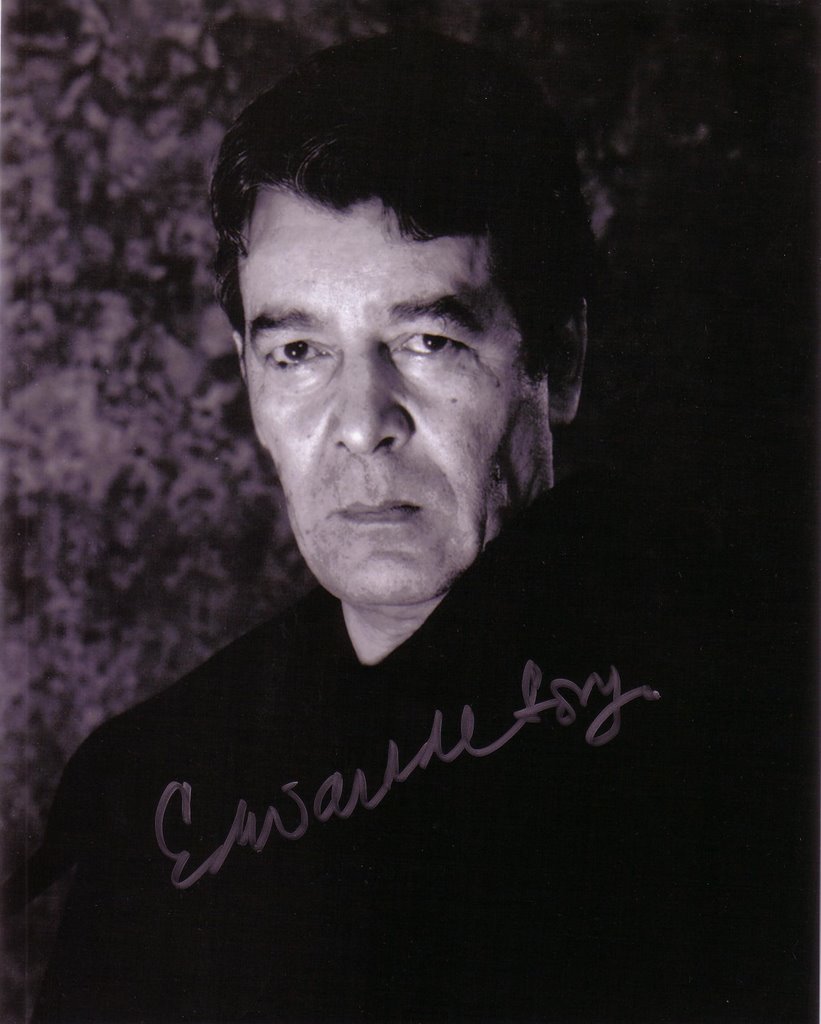
Edward DeSouza

Eclipse of the Kai is read by Edward DeSouza  who back in 1991 had a regular gig reading Radio 4's horror anthology Fear on Four (currently on 4Extra) as the Man in Black at the time -  a post now held by Mark Gatiss of League of Gentlemen, Sherlock and Dr. Who fame. DeSouzas sonorous, sightly gravelly voice is perfect for horror, up there with Price or Cushing, if not as well known for those kind of roles. He does accents and voices for the different characters,  which are all, bar one, very good. DeSouzas delivery seems slightly rushed, not sure whether this is to give it a sense of excitement, of pace, or meerly to try to fit as much of the story before the C90 tape runs out, but this is a small criticism, overall it's a decent performance and quite listen-able.

So In an effort to lift myself from blogging lethargy, I'll listen to one part (each side of the tape) and write a post about it, on a Wednesday - "Lone Wolf Wednesdays" I'd call them, but that sounds like some kind of American sales promotion, or tabloid TV-news soundbite for an ocd mid-week serial killer, and I dislike alliteration at the best of times, so "Radio Free Magnamund" it shall be.

As noted, there doesn't seem to have been an MP3 release, but the audiobook can be picked up 2nd hand from Amazon for around £7 incl. postage.