Crooked Dice are currently running a Kickstarter that includes a number of miniatures based on my concept art.
Sculpted by Ari Níelsson, and painted by Matthew Leahy, both have done outstanding work on bringing the concepts to life.
For me the project started a while back, when Karl at Crooked Dice asked if I wanted to do some concept drawings based on The Breakfast Club and the 1980s Dungeons & Dragons cartoon for the 7TV Feature Pack Night Terrors, in which a bunch of teens in small town America undergo all manner of strange adventures following a flying saucer crash. Of course, being a fan of both D&D and John Hughes movies, I jumped at it!
Having grown up in the 80s the pop-culture touch-stones are clear, but realise they may be completely opaque to someone who may never have had the experience of riding on a Dungeons & Dragons themed amusement park ride and ending up in a parallel universe or having sacrificed an entire Saturday in school detention with a bunch of angsty New Wave delinquents.
So let's explore something of the history of these things alongside some notes on the designs...
What if this was filmed as a mid-80s 'Brat-Pack' movie?
First published in 1974, Dungeons & Dragons is a roleplaying game by Dave Arneson and Gary Gygax in which players take on character roles distilled from 1970s Swords & Sorcery genre tropes and immerse themselves in an imaginary fantasy world of monsters and adventure. By the early 1980s, the games commercial success led Gygax to seek merchandising deals for the burgeoning D&D brand, including toys, colouring books, lunchboxes, stationary, etc. and eventually heading off to Hollywood to secure D&D as a mass-media property. The main product of this endeavour was the 1984-85 animated Dungeons & Dragons tv-series produced by the American Marvel Productions (set up to produce Marvel IP into cartoons, notably Spider-man, himself no stranger to playing D&D-esque games) and the Japanese TOEI animation studio (responsible for everything from Transformers to Dragonball).
The world of Dungeons and Dragons was brought to the small screen. Taking it's visual lead from the designs for the 1982 LJN Advanced Dungeons & Dragons toy range which were based on the dynamic, comic-book illustrations of Tim Truman and the clean, rich colour paintings of Larry Elmore and Jeff Easley, this was D&D at it's most pop art, slick and commercial, a far cry from the original games black and white, low production, high imagination, diy ethos. While several of the LJN toy range characters and monster designs turn up in the cartoon series, the character designs for the Adventuring Kids generally follow well established fantasy tropes from outside the D&D factory - Eric the Cavalier is clearly derived from Hal Fosters Prince Valiant, Bobby the Barbarian fromMarvel's Conan, Presto the Magician fromDisney's Sword and the Stone version of Merlin etc. Well worn references that make the characters and their types easily recognisable to an audience familiarising itself with late-midcentury fantasy media tropes.
"Fear not... Ranger, Barbarian, Magician, Thief, Cavalier, and Acrobat."
- Dungeons & Dragons (1984)
The appearance of a D&D cartoon was by no means universally welcomed as a good thing. Outraged British D&D players took to the letters pages of White Dwarf Magazine (back in the 80s, before WD became one long Warhammer advert) to decry the LJN "bendy" Dungeons & Dragons plastictoys, to complain about the 'kiddification' of their hobby and how the cartoon misrepresented the game. This possibly happened in the USA as well, but as the main roleplaying game magazine in the US - Dragon was strictly controlled by the company that published D&D, dissenting opinions tended not to get published. Part of the perceived misrepresentation was the transformation of the world of Dungeons and Dragons from being a self contained secondary world (like The Lord of the Rings), into a portal fantasy (like The Lion the Witch and the Wardrobe) where contemporary characters, in this case, our cast of teenagers, are transported into a fantastical world as themselves, rather than playing avatars within an imaginary space.
The idea of "American teenagers transported to the Dungeon Dimensions" presents a reasonable answer to the question of what might an 80s D&D movie have been like had Gary Gygax managed to get it off the ground. The teen-movie angle adds a another layer of signification, not just presenting the classic D&D player character classes, but blending and juxtaposing Swords and Sorcery derived imagery with American Teen Movie tropes - something like the infamous anti-D&D movie Mazes and Monsters(1982), but gone right...
What if The Breakfast Club formed a D&D group?
The high pope of 80's teen movies was undoubtedly director John Hughes who carved a name out for himself and leading actress Molly Ringwald, through the mid 1980s, charting the ups and downs of suburban and small town American adolescent-hood. It's unlikely any kid growing up in the 80s escaped the decade without having seen at least one, if not all of Hughes moves, somewhere between cult classic and mainstream success. The Breakfast Club (1985), follows a group of American teen schoolkids on an epic quest of self discovery, snogging in stationary cupboards, impromptu group therapy, running in the corridors and smoking dope in the school library all during a single Saturday detention.
The themes of social cliques, stereotyped identities and roles played by high-school teenagers echo throughout all of Hughes movies. Much as Gygax and Arneson had distilled and enshrined midcentury Sword & Sorcery character tropes into D&D, Hughes distilled and enshrined Teen Drama character tropes into his movies. It's important to remember the entire concept of "The Teenager" was invented by Don Draper in the 1950s as a way of selling soda-pop and rock and roll records, the concept didn't really exist before then, and the social dynamics and trends of 1950's continues to haunt the concept to this day. By the 80's the Teeny-bopper cliques of Socs and Greasers, expressed in Francis Ford Coppola's film adaptation of 50's throwback The Outsiders (1983) - had become Hughes Richies and Motorheads, the tropes endlessly regurgitated permeating the pop-culture landscape in recognisable but mutant varieties.
The Breakfast Club is undoubtedly a classic of it's time. The overall message of empathy and understanding dissolving apparent social divides, with it's quest for identity, championing the underdogs, sub-Philip Larkin observations on parents, there was much to appeal to an 80s angsty teen. The film shows casual drug use in a not completely negative light, while the First Lady's Nancy Regan's 'Just Say No' anti-drugs campaign was in full swing at the time, giving it a slightly rebellious, transgresionary edge as does the characters revelation that made up social categories are, indeed, just as made up as any D&D role.
The movie is widely regarded as being let down in the final act by the make-over of Ally Sheedy's character Alison Reynolds, whose final scene transformation from her cute casual-goth style for an awkward formal-preppy look is viewed as a mis-step on many levels. The films portrayal of the female characters as datable decorative commodities is dubious, and the message that social acceptance is obtained by code switching from the 'rebel' to the 'hegemony', is required for the female, but not male characters, to gain acceptance always felt suspect. Then again, most people acknowledge the all important, titular prom dress worn by Molly Ringwald's Andie Walsh in Pretty in Pink (1986) is pretty awful as well, so perhaps what people really find objectionable is Hughes terrible 80s fashion sense. Meanwhile Hughes musical direction including Tears for Fears, Psychedelic Furs, The Smiths, New Order, is impeccable in it's bang on-trend post-punk credentials - and a huge inspiration for bootlegging Night Terrors OST / inspiration playlist on a 5 pack of TDK D60's.
While Hughes films openly touch on ideas of identity-formation and class, with the themes of rich vs. poor, and high-school clique tribalism, the casts are almost entirely caucasian. Unfortunately the only non-white character with any screen time at all in any of Hughes films is the knob joke named Long Duk Dong (Sixteen Candles 1982) an excruciating caricature of a Chinese exchange student, not even a Chinese American, and whose every appearance is with pinky-plonky stereotyped 'Chinese' music. Fortunately in the 7TV Tangent Universe two characters have been cast from African-American backgrounds. Spreading the net a little wider, reflecting the greater diversity of the D&D cartoon and perhaps a more grounded portrayal of the 80s High School experience.
So there we have it, actors playing american teenage movie character tropes, playing Dungeons & Dragons characters. Our Adventuring Kids didn't magically transform into their Fantasy characters but are instead placed inside the costumes, and given their accoutrements. Imagineering the drawings as Cartoon model sheets for an animated series based on Warrens & Wyrms, the alliteratively titled hit roleplaying game and cross-media property of the 7TV Tangent Universe, got to work doing the drawing... it's time to meet the team...
The Gamesmaster. Based on Molly Ringwald in The Breakfast Club. The Dungeonmasters robes transformed into a loose fitting, off the shoulder batwing sweatshirt. Being the easy going, confident leader of the pack, full of ideas and really quite excited about the whole thing. "Hey guys, I've got an idea!".
The Paladin. Based on Gary Coleman (best known for playing Arnold in Diff'rent Strokes). Again, like the Gamesmaster, the response to being inside a D&D adventure one of excitement. Sir Stannar's oversized full plate armour features a lion motif, use as a chivalric heraldic device and in reference to the African heritage of the character. Incidentally in one episode of the sitcom Diff'rent Strokes (1978-86)- The One Where Arnold Gets Arrested For Stealing A Spiderman Comic, there's a whole bunch of AD&D books on display in the shop. "To Victory!"
The Thief. Based on pre-transformation Alley Shreedy in The Breakfast Club. Leaning heavily into the layered 'covering up' look, associated with teen awkwardness and the Thiefs cloak (Grey Mouser). Tilde's heavy bangs covering her face as much as possible, oversized tunic-sweater covering body, and of course 80s leg-warmers. In many ways the antithesis of Shiela from the D&D cartoon's minidress, thigh high boots and occasional panty shot (thanks pervy animators!). Of course everything is being taken in grim and perilous seriousness. "...".
Barbarian. Based on Emilio Estivez in The Breakfast Club, something of Sean Austin in The Goonies and Corey Feldmen in The Lost Boys. Mulleted 80s kid into American Rock, Bon Jovi, Guns & Roses, Wrestlemania, Double Denim, Monster Trucks. He carries a little weight, large boned, and 'puppy fat' not heroically muscled. Also trousers. The references from the Flintstones Bam-Bam, through Barry Windsor Smith's Conan (1970) to He-Man (1981) through to Bobby in the D&D cartoon. Clearly Bor is using the opportunity to healthily express anger issues in a barbarian rage. "It's clobbering time!".
Dwarf. Based on Lisa Bonet (best known for Denise in The Cosby Show). Diane from the D&D cartoon is often relegated to a background character, while most of the other Adventurers get their own spot-light episode story, or dramatically, Diana just hangs around at the back, occasionally using her Acrobat skills to do something acrobatic. Instead of being a wall-flower, a tall girl trapped in a Dwarfs costume, gets a little bit more of Eric's "give me a break" attitude. "Playing a game is one thing, but having to live like this is ri-di-cu-lous!"
Magic User. Anthony Michael Hall in The Breakfast Club. As the 'brain' or 'nerd' he's undoubtedly well versed in sci-fi and fantasy, so his spell-casting hand gesture reflects classic Vulcan greeting from Star Trek. k. I have him holding a tome with Dave Trampiers Demon idol from the 1978 Advanced Dungeons & Dragons Players Handbook, and oversized, ill-fitting robes similar to Jeff Easley's 1983 PHB cover and Ringlerun from the LJN toyline. In contrast to Presto from the D&D cartoon, this nerd’s more than happy to finally wield the 'real magic', maybe on the edge of sanity but not quite criminally insane Pardu from the infamous anti-D&D movie Mazes and Monsters (1982) . "Klaatu barada nikto!".
And there you have it. Oh and did I mention that the Paladin can also summon an Afro-Futurist informed, Pharoh nemes headdress wearing, Lion motif emblazoned, Rammellzee robotic, Japanimation inspired Gen1 Transformers / Voltron / Dai-X style giant robot battle armour?
Overall the Adventuring Kids for Night Terrors was a fantastic project to work on. I hope we get a return visit to the strange mixed up world of 7TVs Warrens & Wyrd, there's certainly scope to expand the core D&D classes with more 80s teen actors, and perhaps even explore some villains on the dark side...
Meanwhile, for more models, including some suspicious FBI types, 80s kids without their D&D attire, the Night Terrors "the 80's teen sci-fi horror show that never was" Feature Pack, which also feature isometric maps and prop illustrations of magical polyhedra dice by me. And the small-town USA pre-printed MDF terrain, including a modular High School for these Dungeon Punks to practice lock-down procedure. All on the Kickstarter page here: http://kck.st/4hOaYDz
Rent-A-Ghost is a one page role-playing, comedy story-telling game about very odd ghosts doing very odd jobs, strongly influenced by 1970s children's television, improvisational theatre and scoffing sweets!
Each player creates and takes on the role of a peculiar ghost, hired by Rent-a-Ghost Ltd. to solve a problem for one of its many awkward customers. All the players help generate the situation, and then work together using their stupendously spooky supernatural powers to save the day, all while sharing sweets and trying to make each other laugh.
Madcap mayhem for 2-6 players.
Players require 12 sweets (each) and a pair of standard 6 sided dice.
The design impetus for Rent-A-Ghost came from the observations on D&D as Mastermind, a ludological framework where one player (the Mastermind/DM) creates a puzzle (the code/dungeon) for the other players to solve, and flipping that over and flattening the hierarchy to the other role-playing extreme of parlour games, fairy tea parties, collaborative story-telling and improvisational theatre. Quite a radical departure from [ZHU] Industries usual output, but if GW can do Troll Games, then we can do 70s TV Impro Panto...
Some notes on the Dedications and Thanks.
Bob Block (1921-11) was the writer of the BBC TV series Rentaghost, the memories of which inspired the framework of Rent-A-Ghost.
Michael Staniforth (1942-87) was the unbridled talent that the central ghost character of the TV series, Timothy Claypole, who also sang the annoyingly catchy theme song.
Mark Fisher (1968-17) was a cultural critic who, via the electronica of David Sylvians Japans Ghosts brought Jack Derridas concept of Hauntology to popular culture, centring how historically idealised and anticipated futures continue to haunt the imagination and material culture.
Keith Johnstone is a dramatist, best known for his work in improvisational theatre. His codification of the 'yes and...' rule of improvisation in his 1979 book Impro: Improvisation and the Theatre gave rise to the central mechanic of Rent-A-Ghost, and his writing on mask work was instrumental in the barebones character design of the Quirks and Kinds.
John Tynes is a game designer of the Puppetland RPG. I read this in a 1996 issue of Arcane magazine I got in a joblot of RPG stuff, and swiftly sold on. However, Johns game stayed with me. It's horror-movie Punch and Judy and grim-dark raggydolls, the central conceit of speaking in character and describing actions had a large influence on the playstyle of Rent-A-Ghost.
Anyway, despite the incredibly ridiculous nature of the theme, the 'verb'/cost and 'yes/but'/cost mechanics provide a solid set of constraints for group storytelling, and I hope the game inspires some daft and silly fun around the table. Download Free at:
Joe over on Uncaring Cosmos recently posted some interesting thoughts on early ludological influences on the development of tabletop role-playing games, and some strands of influence on early adoption of Dungeons & Dragons that I've been thinking about again recently. Curiously both strands feature simultaneously on front cover of Games & Puzzles magazine #23 from March/April 1974.
Games & Puzzles #23, March / April 1974
Games & Puzzles was a general interest games magazine, a colour-cover glossy magazine on the shelves of newsagents and WH Smiths, distributed by the vernerable satirical magazine Punch. Launched during the boardgame boom of the mid 1970s Games & Puzzles carried regular columns on crossword solving, chess, scrabble, reviewing latest releases of everything from the latest childrens TV tie in stocking filler to abstract cerebral MENSA-level entertainment through the entirety of the Second World War in hexagons and d12 tables and everything in between.
Historically, I think it is sensible to talk about pre-D&D ludological frameworks - games, methodologies, ideas and discourses about games - that may have influenced the early adopters of D&Ds understanding, approaches, acceptance and adopted playstyles of D&D itself as separate from post-D&D frameworks that may have influenced early-majority of D&D, as those frameworks appearing in a post-D&D landscape may have already been influenced by the innovations of D&D itself. So while my personal introduction to RPGs was through Fighting Fantasy, it's a second-generation development, indeed, originally created by D&D early adopters Steve Jackson and Ian Livingstone to explain D&D, and while FF might have influenced those (like myself) caught up in the 80s D&D boom, it didn't provide impetus for the initial, original acceptance, success or development of D&D when it was published.
There is, unfortunately something of a presentist tendency in fandoms to back-project concepts, for example there's an 'eternal discourse'* about "D&D separating from 'wargaming roots'" (as pernicious as a myth as Warhammer emerging from 'roleplaying roots') without really indicating much of an understanding that what "wargaming" really meant in 1974, or any expectation that it might actually be a bit different from the understanding somebody carries around in their head in 2021. Much same in Tolkien fandom, where The Hobbit is forced to fit into the "world" of The Lord of the Rings, while it's textual relationship to The Silmarillion is widely ignored due to authorial comments taken out of context, and that the evidence - early drafts - aren't widely read within fandom. As ever, the only way of escape these infernal traps is to actually look at the original texts.
Games & Puzzles #23, March / April 1974 Mastermind 1973-ish Setting Up a Wargames Campaign, Tony Bath 1973 (1978 edition) Dungeon Masters Guide 1979
The Games & Puzzles article by Tony Bath on his Hyboria wargame campaign has comments from several players, including wargaming legend Donald Featherstone. What they are describing in todays parlance would probably be described as a 'freeform play-by-mail domain level roleplaying game', but at the time was simply a Wargames Campaign. Each player controls a king, emperor, overlord or some-such individual who rules over a land loosely based on RE Howards Conan the Barbarian stories. Bath mentions, with some humour, disallowing plays based on works other than Howards original stories - gaming as an extension of S&SF fandom, where debates about 'canonicity' and legitimacy provide much of the interest. Bath fully admits to controlling the rules of the world as he sees fit - in a dictatorial manner rather than the democratic mode Bath ascribes to Midgard, and thus, the fiat of the Dungeon Master is firmly established. Needless to say, the idea of an impartial but all-powerful (and all-knowing) umpire is as old as modern wargaming, going back to von Reisswitz 1812 Kreigsspeil,but how that might have framed approaches to D&D in the 1970s is, perhaps a different story.
Games Illustrated. Boris Vallejo 1984 (post-D&D)
Featherstone writes about being given the character of Conan to play, and subsequently making game decisions in character, and much is made of the games in-world newspaper and the ability for players to focus on their areas of their interest, and for the narratives emerge from play within the structures of defined rules, including those for generating and playing the personalities of the non-player characters who fill the courts and high ranking military positions within each players nation, alongside the initial conditions of geography, supply-chains and Baths judgement. The 'emergent narrative' isn't something I've noticed much in RPG discourse, GNS 'theory' seems to entirely miss the point by essentialising and compartmentalising aspects which are actually complementary and fluid. However it seems to have been a strong element of what a "Wargames Campaign" actually was - a story that emerges from the decisions made by the players within the game system. I digress.
There is no question that from a British perspective, that the G&P Hyboria article is a pre-D&D artefact, given that D&D had only just been published in the US, and Games Workshop wouldn't start importing it until 1975. The appearance of Hyborian discourse around fantasy gaming, the playing of roles and emergent narratives, within mainstream games media of the time seems remarkable in itself. It's hard not to see the reception and ludological frameworks in the milleu in which D&D was adopted as being informed, if not already established by discussions of Hyboria, (and perhaps Midgard) that employs diverse play-styles some of which would later became synonymous with 'role-playing' but at the time were just an integrated part of the broad fertile plains of the 'wargaming' landscape. I direct interested readers to Jon PetersonPlaying at the World, his book deals with Hyborea and D&D topic quite comprehensively, or to undertake your own research into Tony Baths HyboreaTiny Tin Men provide a good access point to much of the published material. It's clear that Bath had been playing Hyborea since the 1960, but to what extent the elements Bath and Featherstone describe in Games & Puzzles were part of the 1960s game would need slow careful and thorough exploration through the evidence. Nonetheless, the main point isn't to claim Tony Bath invented fantasy roleplaying before D&D, or had influenced Arneson & Gygax or even David Wesely's late 1960s Braunstein games in some way, but rather that only a mere matter of months prior to D&D manifesting on the prime material planes, Hyboria was being talked about in the mainstream, popular gaming press, and the dissemination of those ideas may have informed the approach to Fantasy Gaming in general and D&D in particular of a broader general audience, especially in a British context of a general gaming audience than a specialist wargaming audience.
Outside the mainstream, popular gaming press, in the small-press gaming zines there is post-D&D documentary evidence of a direct influence of Baths Hyboria (rather than an airy 'ludological framework') in the 1977 contribution to D&D APA-Zine, The Wild Hunt #12 by Bryan Ansell (Founder of Citadel Miniatures, Warhammer instigator, Games Workshop Managing Director, Laserburn designer etc.) . In his brief overview of "'how we do things in Nottingham" he references expanding the social role of D&D characters using Baths Setting Up A Wargames Campaign (WRG, 1973) which published world-building and characterisation guidelines that Bath established during his Hyborian campaign. And as is the increasingly knotted nature of these things, in the same article, Bryan also mentions using Greg Staffords White Bear and Red Moon (1975) board-wargame set in Glorantha as a basis for a D&D campaign - a year before Runequest (the official Gloranthan RPG) was published.
After "Wargaming" a second thread of ludological influence taken up by the early adopters of D&D is undoubtedly boardgaming. Joe at Uncaring Cosmos cites the aforementioned White Bear and Red Moon, (which provide a cover feature for G&P #61, June 77 by Lewis Pulsipher) although as an example to think about it's a little bit of a cheat, as WBRM is a Board-Wargame in the hex-and-chit style Board-Wargaming of Avalon Hill, rather than a 'pure' board-game.
Semantics aside, Joe's point that boardgames should be considered as providing a ludological framework for the understanding and development of D&D by some of its early adopters stands up to scrutiny. Consider the case of the boardgame Diplomacy (1959), which under some definitions might be considered a wargame but was popular and prelevant enough to establish its own discreet presence beyond both the miniatures table-top and the hex-and-chit "Wargaming" communities. As D&D emerged from the dank and dismal regions it swiftly became taken up by those involved in the Diplomacy zines and the postal diplomacy scene. While it might seem that simply because of the printed (mimographed), nature of much Postal Diplomacy fandom and its physical manifestation in a vast treasure-trove of play-by-mail zines means that Diplomacy fandom simply produced more evidence of itself than other, quieter areas of gaming, it is fair to say it probably did have greater direct influence on the British early-adopters than any other single pre-D&D influence. Luminaries such as Ian Livingstone, Don Turnbull, Lew Pulsipher and Hartley Patterson all go through the revolving door of 'Dippy' and D&D. Ludologically there is the built-in social-negotation aspect of Diplomacy that makes it particularly akin to the adventurer-player team D&D, wheras in something like Chess, making deals, persuasion and cajoling between players is working against the system, in Diplomacy, as D&D, it is an intended consequence of the system. One of the main innovations of Postal Diplomacy in thematic terms was to use the game to play J.R.R. Tolkiens Middle-Earth, Frank Herberts Dune or some other fantastic realm from SF&F literature, and like Baths Howardesque Hyborian Campaign foreshadows D&D as essentially as a gameable extension of SF&F fandom. The biggest ludological change from board to postal Diplomacy is the introduction of a non-player umpire, whose role it is to collate the orders sent in each turn and return the results in an unbiased and even manner - no doubt helping form the attitudes of those familiar Diplomacy with who would assume the mantle of the Dungeon Master.
Mastermind 1972 Monster Manual 1977
Another, perhaps more widespread game but less documented example of the a similar ludalogical framework may be seen in Mordecai Meirowitz code-cracking game Mastermind - a game of cunning and logic for two players. An award winning 1972 plastic implementation of the abstract pen and paper game 'bulls and cows', given a slightly more sophisticated James Bond-esque slant to the marketing. The game was "selected for the Design Center London", won Game of the Year 1973 and given a Queens Award for Export, sales boomed, national and international competitions were spawned, and Mastermind became a mainstay of Games & Puzzles articles, peg-trays haunted the G-Plan sideboards of suburbia and Hoover Junior Upright Vacuum cleaner bags were filled with multicoloured plastic pegs across the country and around the world.
The other 1972 Mastermind - Approaching Menace
Mastermind establishes a clear separation of roles - one player sets up a code, the other player then attempts to solve it, both working within the rules and restrictions of the game system, rather than say Chess or Diplomacy where each player is essentially playing the same role against each other. This could be seen to both echo and reinforce the playstyles of early D&D - one player is the Dungeon Master who sets up a dungeon, and the other player(s) attempt to 'solve' it, both within the rules of the game. Certainly we can see this Rudolpho's review of Ken St. Andre's, admittedly D&D derived game, Tunnels & Trolls (G&P #61, June 77) where the still nascent genre moniker 'role-playing' isn't used at all, and the review focuses heavily on explaining how one player 'sets up a dungeon' and the adventurers then 'solve it', both working within the rules of the game. So, through the lens of Mastermind we can see the idea of the Dungeon Master not only being the setter of the dungeon-puzzle but also being the non-adversarial respondent to the players actions, the setter in Mastermind isn't trying to block the other player solving the puzzle, but rather to impartially respond to the players plays, and facilitate their exploration of the code-dungeon. Not that anyone would express it as such at the time, but the ubiquity of Mastermind, may have helped establish a ludological framework that prepared a more mainstream audience for certain D&D play-styles.
Some of these concepts, a notion of 'dungeon-as-code', Dungeon Master as neutral code-setter / facilitator, players creating emergent narratives, seem essential to the OSR playstyle in ways that many of the post-D&D influencers miss, certainly it suggests development of investigative playstyles both of the dungeon-crawl with a 10-ft pole type as well as the mystery-solving of the whodunnit and explorations into the supernatural. It's also a reminder that D&D, or RPGs, or Wargaming do not exist in a isolation, and that while fandoms become increasingly ouberous like in their self consumption, it was once entirely necessary to glance into adjacent spaces to provide ways of thinking about what are now known as 'TTRPGs'.
"I do not come to you as a reality; I come to you as a myth."
- Sun Ra
"We do not really mean that what we are about to say is true.
A story, a story; let it come, let it go"
- Traditional African folktale beginning.
The history of the Warhammer Pygmy is a short one. Forgive the pun, it won't be the last. Their history begins in 1984 and ends in 1988, and represent the only Warhammer race of explicitly African origin.
Warhammer is (was) a Fantasy Battle game, a tabletop wargame heavily influenced by the literary works of J.R.R. Tolkien, Michael Moorcock, and Dungeons and Dragons - regurgitations of well worn northern european fantasy tropes. Warhammer also drew on alternative history, the geography and many of the peoples obvious caricatures of real-world historical people, and also began to eschew the purely Eurocentric setting of generic fantasy for the further-reaching land of Lustria.
Pygmy | Warhammer 2nd Edition | 1984
Introduced in 2nd Edition Warhammer Battle Bestiary, alphabetically sandwiched inbetween Tolkienesque Orcs and Von Danikenesque Slann, sit the little cannibal Pygmies.
A quick statistical comparison against the human baseline shows us:
Attribute
M
WS
BS
S
T
W
I
A
Ld
Int
Cl
WP
PV
Pygmy
4
3
3
2
2
1
3
1
7
7
7
7
3
Human
4
3
3
3
3
1
3
1
7
7
7
7
5
Strength and Toughness lower than the standard human. Pygmies are the cheapest troops available in the whole game. Having such a low profile, arming and armouring them becomes cheaper than larger and more powerful troops. They do have access to blow-pipes and poisons which might give them some chance at defeating their enemies, and of course, point-by-point they'll outnumber anyone.
2nd Edition is also packaged with an introductory scenario, The Maginficent Sven whichalso brings us a tale of Pygmies having a feast to celebrate the release of a Norse captive (they'd killed 120 of his fellow adventurers) and roasting the said prisoners leg as center-piece to the feast, while plying him with beer. Of course this is meant as dark humour, but things like this are actually being reported as real events, although with real-world Pygmies of the Congo as the victims, and neighbouring tribes as the oppressors, so it's not really all that funny. Nonetheless, the story shows the Warhammer Cannibal Pygmies having the upper hand both morally, with a warrior code of honour, and physically over their dirty thieving murder-hobo (white) Nordic aggressor.
Cannibal Pygmies in the Jungle of Doom 2004
Still, the Cannibal Pygmy myth seems to have some entertainment value. Sure "other things exist" isn't really an excuse. Some tribes of Pygmies are reported to have practised cannibalism, and whether true or not it does inform contemporary notions of what 'pygmies' is meant to signify. It's worth noting that Pygmy itself is an ancient greek word for a mythical race of crane-fighting dwarfs - the term being applied by white imperialists to various tribes of the Congo.
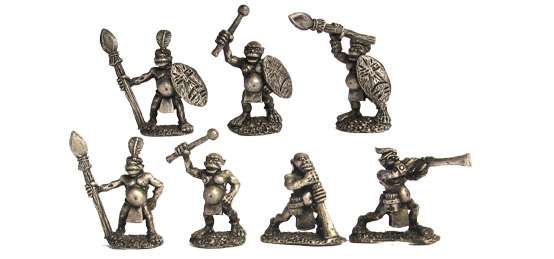
Around a year after the rulebook was published, Citadel Miniatures released figures sculpted by Alan and Michael Perry. the C27 range consisting of 10 different designs.
Citadel Journal Spring 1985
The Spring 1985 Citadel Journal gives us some line artwork, from the pen of Dave Andrews or John Blanche I think, and neither of their finest hours. There is also a change in design direction of the figures themselves from the initial illustration as the original drawing definitely has hair (and furry ankles - amaShoba like the photo of traditional Zulu costume below) and the blowpipes no longer need a stand, and are of a fluted end design, rather than the thick, striped didgeridoo type affair seen in the Warhammer 2nd Edition Bestiary.
Zulu Warrior Angus McBride
The spear, shield designs, feather head-dresses are evidentially taken from Zulu material culture (see above). The 3rd Citadel Compendium gives us some grainy black and white photographs to peer at.
3rd Citadel Compendium 1985.
Pygmies White Dwarf #70 | October 1985 | Painted by Tim Olsen
The miniatures are undoubtedly rather grotesque caricatures. It's often argued that features have to be exaggerated on the tabletop to make things identifiable, and certainly looking at many of the other ranges they are not really any more cartoonish than say, the average Dwarf or Halfling. They are somewhat problematical in that in their exaggerations conform to long-standing derogatory stereotypes of people of African decent.
The problem isn't so much the caricature itself, Games Workshop aren't inventing here, just perpetuating it, but when it is the only creature of Black Origin, the whole thing starts to look a little bit like institutionally racist stereotyping.
The Citadel Miniatures are reasonably hard to track down on eBay, but usually fetch around £4-5 each. Meanwhile Kalistra make some similar looking ones, I don't know if they fit scale wise but their proportions are more naturalistic...
Then, after 1985... nothing. No new models or scenarios or rules, like the Feminist Lesbian Punk Amazons, and the Von Daniken Slann and the rest of the Lost Continent of Lustria the Pygmies just faded away into deep tropical mists. Warhammer Fantasy Role Play is released with no Lustrian content, instead extending Albion and the Old World with its Fimir and Zoats and Germanic Empire. Until...
Note: the White Dwarf is a black guy.
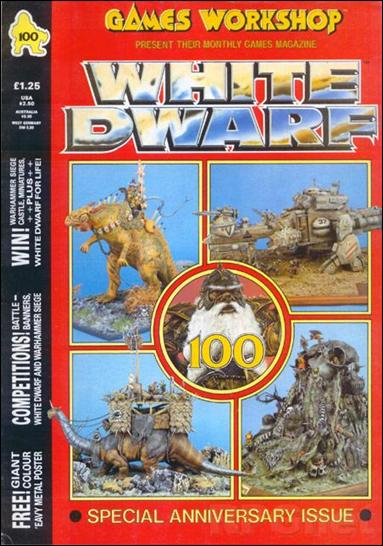
To celebrate it's 100th issue, White Dwarf published a scenario for the Warhammer Fantasy Role Play game a competition scenario entitled the Hanging Gardens of Bab-Elonn written by Basil Barrett (known for the Doomstones campaign) for the 1987 Games Day convention. It takes the traditional timed dungeon crawl and re-dresses it as a Pygmy reconnaissance mission into a floating pyramid, which unbeknownst to them is set to self-destruct, in T-minus 2 hours.
How much of the background is taken from Richard Halliwells unpublished notes for his Lustria campaign and how much is Basils creation is anyones guess - there are hints of new spells in a forthcoming Lustrian supplement, which never surfaced. The background narrative of the scenario places the race of Pygmies as accidental inter-stellar settlers of the Lustrian continent, after their spaceship malfunctioned and crashed into the tropical jungle. In the wider mythos, the majority of the Warhammer Known World races (elves, dwarves, orcs, men) are considered to be the results of genetic experiments by the alien frog-demons called the Slann, with only Amazons, Lizardmen and perhaps Dragons, being the only truly native races on the planet. So like the Slann, the pygmies have extraterrestrial origins as an advanced, spacefaring culture, who have subsequently lost their knowledge and technology, and after being stranded have devolved into a primitive way of life.
S▽N:R▲ | THE NUBIANS OF PLUTONIA
It is tempting to focus a post-imperialist, post-industrial, post-space-age, anti-modern lens onto the Pygmies. The golden age of high technology has passed and all we have to look forward to is the subsistance charms of neo-primitivism, and such a criticism could be fruitful (shamanism, ancestor spirits all ripe for developing those themes), but as we established above, the characters are clearly based on colonialist caricatures of African people, which combined with their extra-terrestrial origins opens them up to be read in an Afro-futurist context.
Need an introduction to afro-futurism? Watch the 1974 Sun-Ra movie "Space is the Place", it's OK, we'll still be here blathering about Warhammer when you get back, the Floating Pyramid won't really blow up (T-minus 1.5 hours). Bonus points for references to Ingmar Bergmans The Seventh Seal.
Space is the Place - Sun Ra (1974)
Sun Ras "I do not come to you as a reality; I come to you as a myth." is a great expression, and the reaction of the kids is brilliant. Myths of racial identity, ideological formations and cultural norms. We can call these ideas stereotypes or memes or caricatures, but Sun Ra reaches into his Barthesian semiotic toolbox, and uses the word myth. Quite purposefully too - not only does the word myth popularly connote falsehood or lie, but also a thing of power, a story we tell about ourselves to explain our place in the universe. If you watch Sun Ra's film, you'll see he uses multiple negative, derogatory sterotypes of African Americans and purposefully contrasts them with his new, positive Afrofuturist myth.
Apparently within our (globalised, internet-based) culture there is a derogatory myth of the African American who is lazy and eats watermelon, which originated in early American discourses on slavery, and have come to represent an aggressive mythologising of ignorance and stupidity within American culture - and it is a peculiarly American myth, watermelon isn't a great signifier of anything except fruit in these parts. However, we are introduced to the Negro Pygmy hero of the scenario as he is relaxing, sitting under a tree and eating a watermelon, illustrated by Paul Bonner.
Banga Gong
It might be enlightening to contrast this image with that of a 19th C. engraving. (lots of others here which when seen en-masse give a good impression of the overall myth and its relation to its subject in visual culture)
19th C. engraving
In Bonners image, and Barretts supporting text, the pygmy Banga Gong sits in a village idyll, not a plantation, Banga is a free man, not a slave, and has obtained the watermelon through his own work, not through the 'charity' of his masters (or by theft). He's having a rest, enjoying the sunshine and eating fruit, not rabid and drooling with glee. The melon isn't a giant-sized ridiculous slabering thing, and in fact, looking at the colouration and lack of seeds, it's more like a honeydew melon than a watermelon. We may frown upon the use of the watermelon as a symbol, because of its repeated use within a negative mythology, but in the context it being placed here it is not demonaic, it is not a symbol of oppression nor of denying Banga's socio-economic position.
Picaninny
Another stereotype we can clearly read in the diminutive image of Warhammer Pygmy is the Picaninny - a word applied to black children, and to infantilise black adults. The pygmies are short, slightly comical, have a great love of food and buffoon-esque. Of course, in fantasy, the image of a child-like, child proportioned, ravenous pot-bellied fool is a common myth which is more often applied to a certain class of whitefolk - Hobbits are, after all, Pygmys in rural Edwardian English white-face - can we not see in Sam Gamgee a lighter shade of Tom? Perhaps these mythemes stem not from racial tensions but rather rural vs. urban and class concerns... can you make cider from Watermelons Mr Baggins? Hmm. Pass da pipweweed Sam. I digress...
Citadel Halflings (2nd Citadel Journal)
Stupid. Fat. Hobbitses.
Is it 'cos I is a faaaaarrrmeeer?
A minor digression. Oo-ar. Oo-ar.
We are also introduced to the Pygmies twin gods, the god of Work (who nobody likes) and the god of Food (who everybody likes) their followers carry a motif - said to be a crecent moon or a mouth with the smile facing up, or down. An alternative reading of the sign may be of a large slice of watermelon.
Brobat and Beesbok
The Pygmy Gods of Warhammer
Floating Gardens of Bahb-Elonn employs these myths quite blatently, and then recontextualises the cannibalistic watermelon-eating picaninny as a descendant of a race of advanced alien astronauts, who have lost their great, spacefaring past and have subsequently descended into primitive cannibalism. Similarly in Sun Ra's movie Space is the Place, negative stereotypes of black americans as pimps, workshy layabouts and gangsters, are contrasted against Ra himself as an enlightened 'angelic being' from Saturn, in touch with both his ancient Egyptian ancestry and futurist astroblackness. What Ra teaches us is that all these ideas are myths, they are all vaguely ridiculous and we do not have to accept them as truths. Indeed a major part of the proselyting strategy of Afrofuturism is to directly contrast the old, accepted social mythology with the new - with the "alter-destiny" as Ra puts it, so that the present no longer has to define the future.
However, the transcendent, redemptive messenger that Ra represents is absent from the game scenario itself, and this is problematical in terms of representation. The Afro-Futurist as central agent is missing, the whole scenario would be thematically stronger if it were actually portrayed in some form, rather than alluded to in the back-story. Yet if the players manage to win the scenario (which is no walk in the park) our heroes reclaim their historical birthright and become masters of the spacecraft-pyramid, they effectively become Ra. and in this game as signs-system - it is the active, primary role that must be fulfilled by the player.
SUN RA
As such we can see the central theme being one of transcendence and reclamation, of moving from one (derogatory) mythical form - the picaninny watermelon stereotype, to a new (transcendent) form - the spaceship-pyramid flying Afrofuturist. And more significantly, this doesn't occur through an external agency of a Prophet or Pharaoh as Sun Ra would have it (with himself as phaero-prophet), but through the agency of the individual hero.
If we turn our attention to these heroes, we can see a pattern emerge in the naming strategy:
Brudda Bobb
Probably a reference to Bob Marley. the song One A We by Culture:
Man like brother Bob Marley a one a we.
But most of all to stand by our side,
As the King of Kings, Lord of Lords,
Emperor Haile Selassie I and I, ey-ey.
I and I keep fighting for our rights.
Rubba Dub
A reference to the Rub-a-dub style of reggae, a prcursor to the modern Dancehall style.
Magga Dog
Jamaican patois, translates as "meagre dog" or mangey dog. Peter Tosh guitarist with The Wailers and successful solo artist wrote a song with this title.
Banga Gong
Possiby a refrence to Get it on (Bang a Gong)by T.Rex, otherwise a pun on the words Bang a Gong. Billa Bong
an Australian (Wiradjuri) word for an isolated pond.
To-ka Bong,
Probably a pun on slang for smoking cannabis through a water pipe, should be noted that cannabis is a Rastafarian sacrament and central to Rastafari religious practice.
Shama Beesbok
Possibly from Africaans 'bees', 'bok' = cattle,goat. Shamans of Beesbok are responsible for food.
Shama Brobat,
Possibly a reference to chemical hygene company Brobat - Shamans of Brobat are charged with making poison for blow-darts.
The names are not racist slurs, and only one or two silly onomatapias (such as other names from Warhammer, such as Slann names, Gottalottabotl - gotta lotta bottle - a milk advertising slogan in the 80s, or the ogre Ezza Ugezod - He's a huge sod)
Instead the majority seem to be affectionate monikers stemming from
Black British culture, Jamaica and Australia being Commonwealth countries - names like Magga Dog and Brudda Bob seem to signify someone with a more than casual acquaintance with Reggae, although we shouldn't discount a cheap compilation LP being picked up simply for research purposes. Nontheless takes an informed position, and makes the same kind of irevverent jokes that litter the ground of Warharmmers other imaginary peoples.
The name Bahb-Elonn(the villain) is a classic Warhammer pun. Obviously the pun is on the name of city of Babylon, and the Floating Gardens on its famous Hanging Gardens, one of the 7 wonders of the Ancient World. However, Babylon has a deeper resonance within Rasterfari culture, illustrated nicely by the song By the Rivers of Babylon, popularised in the mid 1970s by German disco group Boney M (themselves no strangers to Afrofuturism, their first album being entitled Nightflight to Venus ) based on Psalm 137 about the plight of the Isrealites taken as slaves into Babylon. Feel free to press play and carry on reading, there's nothing of particularly Afrofuturist note in the imagery here.
In Rasterfari the word Babylon is synonymous with the forces of oppression and is used to denote the State, Police or other anti-rasta authority that stands against the Rule of Jah (God). As we've already seen in the Good character names, Reggae & Rastafarianism is established as part of the myth. It is precisely in this role of the 'downpressor man' that the Old Worlder magician Bahb-Elonn is cast. The only white man in the scenario, set up as a colonialist slave-taker, an evil, powerful magic user, who is worshipped as a false-god by his slaves on his stolen, floating island, and trapped by his own wickedness and lust for power.
There is another mythological slant to this, Bahb-Elonn is a magic user, and his theft of the ancient pyramid-craft is more than a simple reference to european colonialist aggression. One only needs to look at the headline act in 19th C. Occultism - Aliester Crowley to see the appropriated Egyptian symbolism and imagery within the Western Esoteric Tradition, and Crowley can be seen to be culturally (or perhaps even psychically) inhabiting the pyramids themselves, robbing them from their African heritage and re contextualising them within a predominately white, Eurocentric mytheme. Bhab-Elon then can be read as representing the Masonic / Golden Dawns appropriating, claiming for themselves the history and mythologies of African culture for their own selfish magickal gain.
Aleister Crowley in Egyptian garb
In this light, rappers Jay-Z and
Kanye West recent appropriation of Crowley-esque occultic and masonic imagery is less about a
lost pop-stars flirting with a hipster / gothy / witchhouse pseudo-satanism,
or conspiracy-driven Illuminati mind control, but rather a radical cultural tactic to wrestle the imaginative image of Magickal Egypt from the Masons, New-Agers and Occultists and into the hands of Afro-Americans - 'we have returned to reclaim the pyramids' as Parliament sang back in 1975. Besides, Rihannalooks fantastic as a bladerunneresque Koka Kalim ganger, in Run the Town give the girl a bolt pistol.
Big contracts, big contractors
built pyramids, period
We Masters
Jay Z - Free Mason
But unless the multi-platinum darlings of Hip-Hop are funding the Egyptian uprising or attempting to stem the systematic wiping out of the Mbuti in the Congo, just like Mr. Crowleys psychic attack on Hitler in WWII, it lacks any real-world clout, and is ultimately empty narcissistic entertainment glorifying capital and celebrity with themselves as the new overlords - the new Celebritarian Antichrist Ssuperstars to borrow Maryin Mansons extended critique of celebrity obsessed pop-culture.
Enough of that! Back to the Warhammer...
Bahb-Elonns arrogant use of evil magic, his Faustian lust for power and abuse of power eventually traps him into eternal conflict with a daemon, which subsequently causes the immanent destruction of the floating pyramid. The ur-narrative of rebellion and uprising would be more elegantly satisfied by the pygmies confronting Bahb-Elonn head on. Yet perhaps this denial of vengance is a subtle restatement that colonialist masters are still untouchable by their 'lessers' and a final re-assertment of the conservative, white, european balance of power.
An Afrofuturist reading of the Floating Gardens shows it to be actively engaging in transforming myths, subverting negative sterotypes of Africans rather than simply reproducing them and creating an role-playing-game worthy of Ra's 'alter-destiny' whilst also respecting the history of slavery and portraying it as a universally bad thing, without overburdening it with guilt messages. One could level the charge of simply perpetuating certain negative stereotypes against the Floating Gardens, and not portraying the positive ones, but nontheless the negative myth is usurped - not only are the watermelon eating pickaninnies free men, but heroes whose history and future is far greater than they know and it is by their own hands that they will reclaim both...
P.S. Pushed "publish" instead of "save". This wasn't quite cooled, and probably needed breaking into smaller posts. Oh well, it's done now!
DEADMEDIA XIII Teletext art has been featured in Wired UK magazine. web version here and there will be a forthcoming broadcast on German TV channel ARD, with a small launch event in Berlin.
DEADMEDIA XIII in Wired [UK] Magazine,
in your newsagents, near the out-of-date-milk and the Mars bars
Much respect to Juha at the ITAF for his continuing efforts on the international Teletext scene. Awesome stuff. The signal has now been turned off on the London area, so that's it, no more Teletext for me, and there goes a piece of Britains post-industrial heritage.
Teletext is roughly equivalent to Mode 7 on the BBC Micro. It's not the same format as braodcast, but it is very similar. If you've never heard of the BBC Micro, it was a British 8-bit home computer of the 1980s, and was introduced into many schools for educational purposes. The guy who invented it was played by that bloke from The Office (and who is the new Bilbo Baggins) in a documentary. here. It was also the platform of origin for David Braben and Ian Bells Elite, the epic space combat trading game loosely based on Mark Millars Traveller RPG.
As far as I know, no D&D character generator was ever published for the BBC Micro. Judging by the classified ads in old White Dwarf mags, there were a good few homebrew versions for the ZX Spectrum. Notably the D&D Character Generator by Triffid Software Research which includes the White Dwarf Houri class (oo-er missus!), but I haven't managed to get it running past the first 2 levels of character selection before the emulator crashes or something, possibly about tapes. Here's a screenshot of a Dwarven Fighter :
Triffid Software Research AD&D Character generator
ZX Spectrum
And the SSI Dungeon Masters Assistant (C64 and DOS) is also very cool, and official AD&D software, which is what I currently use to create insta-matic dungeon fodder.
DOS version of DMA
Both Triffid and SSI kind of miss the point of a character generator - the user is still 'designing' the character - deciding whether a Dwarven Fighter or a Half-Elf Fighter/Magic-User/Cleric would be a better option, and the SSI lets you fudge stats and ignore the dice. As most people who advocate low-level deadly type D&D know, players who get overly invested in their characters begin with making character design choices, and dreaming up the wonderful heroic adventures they might have playing this idealised, self-designed character, instead of developing a character concept by actually playing the game.
What I want (aka "primary design goal") is to facilitate strict 3D6 in order, random character generation. Reducing chargen time, sticking to the constraints of the rules, and getting into the game as quickly as possible, using old-school technology... type RUN, get a character, that's it. No player input or
decisions, zero time spent in character generation. "But I don't want to
play a half-orc thief chick..." then give her an honorable (or amusing)
death, and type RUN again. Think Nethack, not World of Warcraft, and definitely not 'my Drizzt fanfic'.
So I wrote 17 lines
of code in BBC BASIC to roll 3D6, in order, and output as stats. BBC BASIC (the programming language) was designed to be the Fighting Fantasy Introductory Role-Playing Game of programming, It took me 10 minutes with a bit of help from the user guide. Here is a video
of it running on an emulator.
Anyone who knows anything about programming will tell you this isn't
very efficient code, and what it is doing is mind-bogglingly simple - but the idea is there, and it's starting to produce something...
The Art of the Con
-
Though I attended two conventions recently, I only refereed events at one
of them – CleriCon. At Gamehole Con, I was there solely as a participant,
playi...
A second resurrection for Lord Mortis
-
As the season brings the haunting howls of spooks, spectres and the
restless dead, it might be a good time to pick up the new edition of *The
Keep of the...
Return to Mordheim - Nurglite Spined Monstrosity
-
One of the best things about this hobby is finding the perfect use for a
figure that you've wanted to use for ages. I've had Jes Goodwin's mutant
ogre ki...
Mutants and Death Ray Guns: a mini-campaign!
-
I got six games of MDRG in over the weekend, including a four-game
mini-campaign with three players. Work pressures meant that most of the new
scenery wa...
Stone Acre Militia
-
Have no fear! The militia's here!
Hi! I've got some much needed holidays from work and have been working on
making some militia for an upcoming Brutalq...
Class Wargames Divides Gaul into Four Parts
-
Barbarians against the Roman Oligarchy “The military leaders were chosen
without regard to their descent, solely according to their ability. They
had littl...
Polearms & Proust (or, In Search of Lost Biscuits)
-
A very silly role-playing game about introspective thugs with big pointy
sticks. Inspired by this BlueSky post, and written by someone who has never
read P...
BX DMG Table: Cart & Wagon Encumbrance
-
The other day, I saw that Erik Tenkar shared a video post about how many
mules it would take to haul away the average dragon's hoard (Treasure Type
H). I...
The First Catachan: Luke, the Death‑Worlder
-
Catachan Luke: The First Catachan Model Catachan Luke is the earliest known
Catachan miniature and the first Death‑Worlder produced by Citadel. He
appears ...
Ral Partha Imperial Dragon - Tom Meier 1982
-
My only ever visit to the US of A was back in 1982. I was almost 21 at the
time and the lure of the lead was already deep. I shared rooms with my mum
an...
Star Wars : The Return Of The Jedi
-
Hey boys! Last games of Star wars 80's campaign. The target is to play
games with my son and stick as much as possible of the movie. It very
enjoyable to...
Cilician Armenian Allied Cavalry
-
While most wargamers instinctively reach for Turcopoles when looking to
field regional allies for a First Crusade army, I wanted to build something
a bi...
MAGI: Non Western Wizards/Shaman
-
Plenty of magic users outside of European tradition. Includes figures from
various classic toy solder makers.
Game figures, Wizardry Board Game, Dis...
We Really Need To Talk About Wands (Part Seven)
-
*Wand of Spells **(#23/31, #51/365) [EA:V2] (Enchanted Item)*
This wand is typically made from rare and expensive wood, bound with gold
or silver and st...
Bad Unicorns and 2026
-
Hello all – it is the second month of 2026 and I haven’t yet posted
anything here – so here is at least something. We have been struggling with
S.A.D. and ...
Is it 2026 Already? Oh My!
-
Gaaah?! Is that the year?
That can't be right? My last post was in 2022! Surely there is something
wrong here,
Well there is...all the links seem t...
Dungeon Floor Planners
-
I treated myself to a Christmas present which arrived on the 24th December
luckily.
I had these as a youth, but fancied another look at them. That wond...
On a Happy New Year
-
We are about to experience the most social upheaval since industrialization.
What will that look like in sixty years?
Sinless is starting it's third yea...
Happy Orctober
-
It has become a tradition that I post once a year in Orctober. Rubbish I
know but I do hope to remedy that this coming year. I have been painting
plenty...
Experience with Python
-
Well, it amused me to make it. (Inspired by my Facebook ads.)
But it did get me thinking about how Conan the Barbarian set the bar so
high for 1980s f...
John Dennett Grenadier Stone Golem
-
I adore the work of John Dennett, and have been slowly working my way
through collecting his Grenadier minis. John emails me every birthday.
Sweet guy.
Fi...
Star Wars & 02 Hundred Hours
-
I’ve been playing the wonderful 02 Hundred Hours from Grey for Now games
recently. As thoroughly expected from one of the creators of the equally
fantastic...
Aura - Rain (2013)
-
You proceed into the interior of the tower, looking upward to see that it
stretches straight up into the clouds, which have somehow made their way
into t...
Great Expectations
-
Not long after I’d started reading White Dwarf, like – I suspect – many
other readers, I fancied I could contribute to the magazine too. Given my
love of m...
Playing at the World 2E V2 Arrives
-
With the release of its second volume, the second edition of *Playing at
the World *is finally complete. The two books combined total well over
1,000 ...
Painted Miniatures for Heart of the Empire
-
[image: Painted miniatures for Heart of the Empire Star Wars Imperial
Assault]
*Heart of the Empire* was the fifth expansion for *Star War Imperial
Assa...
Guardians of the Galaxy Vol. 3 (2023)
-
Some very cool suits from the third *Guardians of the Galaxy* movie.
The many colours are a bit of a homage to Kubricks 1968 movie *2001**: A
Space ...
Röknauts Revolution
-
[image: Röknauts Revolution]"Behind each bike blasted knotwork treadtrack,
and ahead blasted scarlet tracer rounds. Forging together iron wills and
iron wh...
When did the OSR begin? 2008.
-
I was looking through a box of some of my old gaming stuff and I ran across
a bunch of old OSR zines and DIY supplements from 15+ years ago. I thought,
w...
Cult of the Hollow Thorne
-
+++ The Cult of the Hollow Thorne is one of the oldest Cults of the Green
Man. It has risen to great numbers recently, as the search for
illumination, cure...
Clearance Sale on Dice Trays
-
50% off remaining foldable dice trays on our Etsy store (valid until March
1st) Clearance Sale on Dice Trays ________ Other news: Although we haven’t
had a...
Why did I need the boost - this is why
-
It only seems fair as I show-off the results of my recent efforts, that I
show you why I needed the boost to my morale - this little lot, the last
knocking...
The Battle of Thráya
-
I recently succeeded in luring Michael Lung over to the house for a
miniatures battle and discussion of Tékumel. If you haven’t heard of
Michael, he is on...
It's been a decade, now...
-
This is a tough time of year for me. So, with your indulgence, here's this
link to a post I did a decade ago... EDIT: I have no idea why it didn't
take. S...
The Spine of Night Premiering at SXSW Tonight!
-
*The Spine of Night* will be premiering tonight at *SXSW*. I am extremely
excited about this one! If the past output from Morgan King/Gorgonaut has
been ...
Oldhammer Fun: My "Citadel Colour" Paints
-
*My private little collection of Citadel Colour paints is all I need. Well,
that and a few good brushes.*
Warning: This is another frothy Oldhammer Blog p...
CCLII. AoS28: Sunhold Deadwalkers and Netopyr
-
*A*t last found a bit of time for my personal projects, so I made a few
figures real quick.
Sunhold Deadwalkers
I'm trying to settle for a definitive ...
Using the Rainy City with Risus: The Anything RPG
-
S. John Ross's *Risus: The Anything RPG* can do anything. It says so right
on the tin.
And, if it is anything, the Rainy City is certainly something!
But ...
The Heroes of Fruglehofen
-
Yes, I know I said I was starting with Gimbrin's Mine... again. Due to
vagaries of the warp or machinations of some evil power I am still waiting
for some ...
Warplan 5/5 Campaign System
-
I'm afraid I couldn't find a way to reproduce the snazzy double headed
arrow in 5/5 in the text so will have to do with this instead.
Warplan 5/5 came o...
Not Necromancy...
-
I am indeed alive! AN incredibly busy year of travel just got more crazy
as the year ended. In between I continued to work and play-test a different
mag...
Sacred Art for the New Year
-
Happy New Year’s Week! The start of a New Year always holds such great
promise … being a completely blank slate — there are 366 days (leap year)
to bring...
Squarehex 2019 Review and 2020 Plans
-
2019 was a good year for the business. The two highlights for me were
getting *The Black Hack Second Edition* rewards sent out to our Kickstarter
backers ...
Dricheans for Frostgrave: Ghost Archipelago?
-
*Some Yan Koryani*
*Painted by Akarsh*
I was disappointed when North Star cancelled (or put on hold?) the plastic
box of Dricheans, the Bronze Age c...
Dark Crystal TV Show
-
*Edit: I have changed my mind drastically about this show. I plan on
writing a follow-up sometime soon, but after watching the rest of episode
1, I watched...
Clear Acrylic Base Saves The Day (And The Mini)
-
My fantasy miniatures have always been game pieces, to be handled and used
from one campaign to the next. Some of my favorite minis are 30 to 40 years
old,...
This is only for followers ...with thanks!
-
Thank you for following and here are a few newer [ish] pieces which I do
hope you enjoy.
They are in no particular order and if some appear to be 'older' i...
The Withered Crag available now
-
I just enabled the sale of the PDF version of The Withered Crag at
DriveThruRPG a few minutes ago, and the custom print version will be
available startin...
The G+ Apocalypse
-
This is where to find me after the fall of the G+ empire. Facebook
https://m.facebook.com/brett.slocum Blog Https://joyfulsitting.blogspot.com
The Tekumel ...
Regarding Zak
-
https://www.facebook.com/amandapatricianagy/posts/10215845527064252
I hope that Zak engages with some sort of accountability process, takes
responsibility ...
A Sojourn Among Antediluvian Archæotheria
-
This started with nomenclature, as so many things do. I started writing a
response to Scrap Princess's post about Dinosaur naming conventions in the
fantas...
Dernier article
-
Hé oui, c'est le fin de Chaotica Cloaquis, sur Canalblog. En effet, après
dix ans de bons et loyaux services, je vais quitter cette plateforme pour
Blogger...
2019 Goals
-
It's been forever since I've posted, and the only gaming I've gotten in is
a Warmaster matchup between Undead and Dwarves. I'm playing against my
son, but...
Please, I don't do paid advertisements - don't ask.
-
A little note since people have asked me about this. My video channel's
*not* an advertising platform, so I'm not available for hire if you want to
promote...
How can We Destroy this Campaign World?
-
d12
1. You must trick a bard into strumming the *Chords of Fate* on the *Lute
of Annihilation*
2. Legends tell of thermonuclear weapons beneath megadunge...
Meet Emrim
-
Meet Emrim. For a dwarf (and a thief*) he's a good sort, and a fine shot to
have alongside you in a fight. Not *behind* you, mind, he's not a perfect
shot ...
The Gates of Death
-
Remember how I started the last entry, for *The Port of Peril*?
Of course you do, you read this blog every day.
The _____ of _____. It's back for this la...
Workbench April 2018
-
So this month I didn't work on multiple projects, it was just full steam
ahead with Super Dungeon Explore...
First up we have the last of the heroes, The ...
Hinterverse, a Glossary
-
Antikytheron, the
Core prognostication device of the Great Machine, origin unknown.
Arcturean Arm
A minor spiral arm of the Hinterverse.
Argos
The birth...
Ral Partha Necromancer
-
Realms of Magickal Sorrow by Old Sorcery
MY first post in December also showcases the first 'evil' miniature I have
thus far painted for this project. Witho...
Ral Partha Necromancer
-
Realms of Magickal Sorrow by Old Sorcery
MY first post in December also showcases the first 'evil' miniature I have
thus far painted for this project. Witho...
Empire of the Petal Throne!
-
The new hardcover and softcover editions of Empire of the Petal Throne
arrived and are available now at DriveThruRPG.com! Here’s a link:
http://www.driveth...
Puerto Rico and Caribbean Hurricane Relief Bundle
-
https://www.drivethrurpg.com/product/220574/Puerto-Rico-Hurricane-Relief-Bundle-BUNDLE
“Puerto Rico was devastated by Hurricane Maria a few short weeks ...
More Kesmai Corporation Isle of Kesmai images
-
Sorry it's been so long since I've blogged here guys. Here's some more fun
Isle of Kesmai images showing the various stages of creating the Isle of
Kesmai...
That Is Not Dead Which Can Eternal Lie...
-
...and in strange aeons, even this blog may be updated.
Believe or not I have a half-written post for* Temple of Terror *that I
intend to complete and publ...
More Rogue Trooper Orks
-
I recently had the chance to make a flying visit to the Warhammer World
shop, where I picked up a shiny new hardback of Warhammer 40,000: Rogue
Trader. It...
Dungeon Accessories: Part I (of many)
-
I have spent a lot of time in the last couple years painting dungeon
accessories. At first I didn't want to, as there really isn't much time
in-game for th...
A solitary Heroquest fimir
-
The handsome fellows over on the Scale Creep blog invited me to join their
Heroquest Hero Quest and I could hardly turn them down. After all, I
had already...
Eureka! Password Recovered
-
Gee, that only took forever. First, I would like to apologize from my
prolonged absence from this blog. There are several reasons. I had some
major life up...
2016 - The Year of Mediocrity
-
Hi.
Happy New Year, I guess.
Better late than never. I mean, if you wait long enough, it will be a new
year somewhere, right? Now that I think about it...
Our bags are packed for the Pacific Northwest
-
The summer seems to be rushing by. I think it feels like that because we
haven’t really had any summer yet. I know, I know, some of you have been
having R...
A couple more Landspeeders
-
It has been a while since I posted any of my Star Wars stuff - my
lanspeeder race project has been on hold for the last couple years.
However, I have 2 com...
Steampunk Militia now on Kickstarter!
-
STEAMPUNK MILITIA KICKSTARTER LIVE!!!
https://www.kickstarter.com/projects/2004599158/steampunk-militia-miniatures
I am pleased to announce the long awaite...
Paper Experiments
-
I tried playing with a limited color palatte and a reduced number of images
today. Everything else was open to whatever I wanted to do; I just couldn't
use...
Every Dungeon had a Dragon....
-
Back in 1980, every dungeon had a dragon in it! There were a few dragon
miniatures on the market at that time, including some nice 'imports' from
Heritage...
Still clearing up '83
-
Ok, this blog update is dedicated to Kevin Davies (no not that one), Shaun
Watson, Steve Clark and the two or three Frothers that commented, without
whom I...
-
Prohibition has ended and so has the shortage of AFS back issues! While
supplies last all 6 issues are available as I recently did a re-print run,
had thes...
The blog is looking for an "editor!"
-
Hi folks
I need to face it: after more than 4 years of running this little blog, it
has become obvious that I can't keep up - other interferences, you know...
-
Not going to be maintaining the FF blog on Google anymore. Mainly because
of this which seems to be the thin end of the wedge.
http://www.theguardian.co...
ECHOLALIACS
-
*Number Appearing:* 2-8
*Size:* 10' to peak of cone
*Armor:* Rolls of thick, dense hide as plate armor
*Resilience:* As 8 human warriors
*Intelligence:* S...
What Happened to VHS Archive?!
-
Some of you may have been wondering, and some of you may not have even
noticed, but VHS Archive has pretty much ceased to operate. I live in
Seattle where ...
I'M BACK!!!
-
Hello everyone I'm back, I am actually still alive and able to paint. Sorry
for the huge absence, last year was fairly shitty and since then I've
completel...
¡Otro dragón en Birmingham!
-
El 5 de Septiembre de 1981 Ian será el encargado de oficiar como maestro de
ceremonias en la apertura de la tercera tienda oficial de Games Worksho...
Interesting Places: Tomb of Yekelil
-
Today's map is dedicated to all my Internet friends who hate blue maps.
This map revisits last year's map of the Tomb of Yekelil, one of the many
levels w...