|
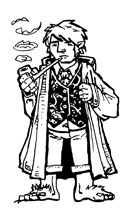
| 10 Archers, 10 Spearman, 1 Captain |
Prompted by Whisky Priest's "How to Oldhammer" to put together a small warband of cheap and easily available miniatures, just to prove to naysayers that Oldhammer isn't some kind of weird exclusive collectors club... I thought what a great opportunity to not only do that but explore some fantasy wargaming history, kind of celebrate 40 Years of D&D and pay hommage to one of gamings greats, and prove that Oldhammer is actually some kind of weird, tweedy, pipe-smoking, beard stroking rambling cult who sit around whittering on about fairytales and the history of wargaming...
But wait, what is he on about? "Gygaxian Airfix Hobbits" what's them when they're at home? To answer that, dear reader, let us roll back the Fomorian mists of time... back... back...
Back to 1970 where the fantasy gaming industry didn't exist. Just imagine. There were no fantasy miniatures being produced, no rules-sets, no role-playing games, no Warhammer, no D&D, only earth beneath us, and above us only sky. There were, however, small groups of gentlemen gamers and vagabond street urchins pushing little models around, inspired by the Fantasy authors of the day, the likes of Vance, Tolkien, Moorcock, Howard. Into this heady, smoke filled arena, enter Gary Gygax, wargamer and soon to be inventor of Dungeons & Dragons publisher and co-author of Chainmail - rules for medieval miniatures including the "Fantasy Supplement" - wherein all manner of Nazgul, Ents, Balrogs, Orcs and Hobbits were detailed for your wargaming pleasure.
Chainmail represents the very first commercially available fantasy wargames rules - WRGs "Suggested Adaptions of Swords and Sorcery Fantatics" wouldn't appear until 1973, and sadly (or perhaps wisely) avoided the wrath of Tolkien Enterprises Legal Dept. and neglected the Tolkienesque in favour of some kind of weird Crusader mythos with religious overtones. Chainmail might not quite represent year zero for Fantasy Wargaming, as luminaries such as Tony Bath demonstrate using ancients rules in their own fantasy setting, but returning to the matter in hand...
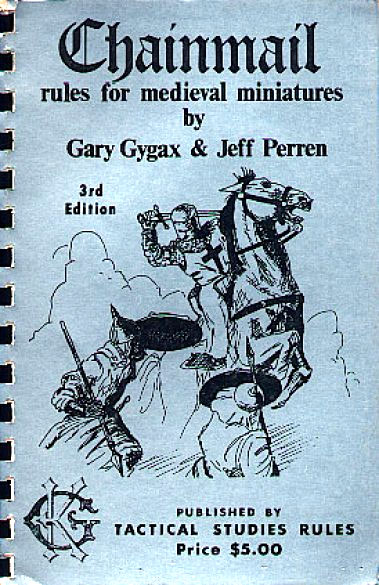 |
| It all started here. Or hereabouts. |
In the Chainmail "Fantasy Supplement" Gary describes Hobbits thusly:
"These little chaps have small place in the wargame, but you may want them for recreation of certain battles. Remember that they are able to blend into the background so make exellent scouts. They can fire a stone as far as an archer shoots, and because of their well known accuracy, for every two Halflings firing count as three on the Missile Fire table."
Nice enough - but no accompanying illustration tells us what this Hobbity "little chap" might look like, or how we might represent such a thing on our tabletops, which is a shame, but very much par for the course on early games - the gamer was supposed to work out for themselves and choose whatever they liked. The idea that there was a peculiar relationship between a specific ruleset and a specific miniatures range had yet to enslave the minds of gamers. Setting the chronometer forward a little to 1971, in an article in Wargamers Newsletter, Gary states...
"...converted Airfix 'Robin Hood' men serve as Hobbits..."
And there we have it, Gary was using Airfix Robin Hood figures as Hobbits, and thus the Gygaxian Airfix Hobbit was born. You can read the full text of Garys article in Wargamer's Newsletter #127 via James Maliszewski's post on Grognardia here where none other than Jervis Johnson issued forth a copy of an extract of a 1972 Wargames Newsletter (edited by Donald Featherstone), and there's a picture below, which you can click, make big, print out on actual paper and pretend like it's the 1970s, maaaan.
 |
| Wargamer's Newsletter #127, from October 1972. via Vintage Wargaming |
 |
| Wargamer's Newsletter #127, from October 1972. via Vintage Wargaming |
But what are the aforementioned Robin Hood Airfix figures like? Well here's a shot of the original packaging, of the type Gary might very well have purchased back in the day...
 |
| Box without hinges, key or lid, yet little green Hobbitses inside are hid |
Airfix don't currently list the Robin Hood set on their website any more - but they seem to be listed in various online retailers, and were widely available in HobbyCraft until a short while ago, with a big red £2.99 sticker on them - passed up by me because I'm somewhat lackadaisical when it comes to shopping. Having "Airfix Robin Hood" on my watchlist on eBay for over a year - determined to pick up a set for under £5 but alas kept missing out, and the ever increasing postage making the likelihood of a total bargain. Found a seller on Play.com selling a box for £4.60 - including postage, for 40 figures. Perfect, I thought, and bought them. Returning to the store they now cost around £7 - still inexpensive in comparison to 40 28mm figures, but the price does seem to fluctuate.
Gygaxian Airfix Hobbits on Amazon
Gygaxian Airfix Hobbits on play.com
And it must be said that Squarehex (purvayors of fine gaming stationary) also have a limited number in stock at a very reasonable price. Squarehex
Airfix - a British company making model kits and toy soldiers - and probably familiar to most readers of this blog from their airplane, dinosaur and military kits, has a venerable place in our Wargaming history. The name continually crops up in the reminisces of the early fantasy wargames scene, be it Joe Dever, Bryan Ansell, Andy Chambers, everyone around that era talks of playing with Airfix models, whether it's giving Romans ray-guns to recreate the comic-book world of the Trigan Empire or just battling out WWII on the linoleum of youth, Airfix provided the entry-drug into miniatures skirmish gaming, perhaps much like how Fighting Fantasy would feed the UK RPG scene a decade later.
But what of the figures themselves?
Here's some superbly based and painted up versions by Paul of Paul Bods.
 |
| via 1:72 depot.com |
The set contains
- 17 archers (inc. "Robin")
- 10 Spearmen
- 10 Hand weapons (inc. 1 Little John "Axeman")
- 1 Maid Marion (mounted)
- 1 Cleric / Wizard / Friar Tuck
From Robin Hood to Old Took
Unfortunately Gary doesn't go into much detail as to how he converted his Airfix Robin Hood figures into Hobbits, nor what his Hobbits looked like. So far my research has not turned up any pictorial documentation of these figures or Garys early Chainmail fantasy games in action - any help would be most welcome on that front.We do know that Gary was eclectic in his use of cheap plastic toys - remember that there were no fantasy miniatures to buy at this time, and improvisation, creativity and affordability were the order of the day. And we know that many of the AD&D Monster Manual illustrations and creatures were based directly on the models being used in Gygax's games (an excellent post by fantasy artist Tony Di'Terlizzi here illustrates quite well). While correlation does not prove causation, it is entirely possible the drawings for the Halfling by Dave Sutherland from the 1977 Monster Manual are based on Gary's personal figures from the Airfix Robin Hood set.
 |
| 1977 Monster Manual Halflings |
And the weapon-types covered in the Monster Manual under the Halfling entry run like so:
For now I will let Dave Sutherlands piece dicate the formation of the Fourth Farthing Irregulars warband, 10 bowmen and 10 spearmen, no armour. I'll definitely convert some of the models in the set with cloaks, backpacks and pole-arms and might add some shields to the hand weapons...
I have to admit that my reconstruction of the Gygaxian Airfix Hobbit is not going to be 100% authentic. My first intentional deviation - the issue of basing.
Gary may well have based his Hobbits on bits of cardboard, or washers, or nothing at all. However, he definitely didn't use the common slotta-bases that appeared in the mid-80s and I'm not either, and it's highly unlikely Gary used British currency, but that is exactly what I'm going to do.
Old bronze coins are still in circulation, and I've been collecting them for a while (and swapping new coins for old with friends and colleagues, much to their amusement) for intended use aforementioned Wildwood Campaign project, so that's why I have an abundance of them. I'd decided to go with pennies for infantry, UK 1p coins, specifically UK 1p coins minted before 1992, not only does this just fall over the threshold of the end of Oldhammer (1991 being the year Bryan Ansell sold the business to it's current management team, and so marks the end of the "Oldhammer period") but also marks the change from a solid bronze coin to a copper-plated steel (and if one were allowed to melt them down, the solid bronze ones would be more valuable). Add to that, I based my first ever Citadel Miniatures on pennies, so there's personal nostalgia there too.
I'm going to be a hard-core numismatist nerd and only used coins dated 1971 - 1972, to fit the creation window before the article was published - I wouldn't have bothered, but going through the penny-jar discovered I have enough, so job done.
These are quick and easy to identify as they are non-magnetic and the pre 1981 coins have NEW PENNY on them and the date on the Queens side, for final verification. The more practically minded of you might see a magentisable base of modern coins as an advantage in storage and transport, but hey I'm going for historical reconstructionist modelling here, not common sense!
However all of this means the basing for this project is going to cost me a grand total of 21 pence. An inordinate sum of money, I think you'll agree. Their low profile and naturally patined brown edge, and slight weight will make them look and feel really nice.
Currently 20 x 20mm bases would cost £6 from GW, so that's a 'saving' of £5.79 over modern Warhammer.
Keeping things authentic, Garys Wargaming Newsletter article was published 1972 - two years before Tom Meier accidentally discovered Green Stuff, so GS is out. Gary mentions "auto body putty" in his article, but I have no idea that that may be. Miliput has been around since 1968, so is in-period for this project, and according to the manufacturer, got into widespread use in the modelling field in 1970 so seems totally appropriate. Over to Amazon to pick up some Milliput Standard Yellow-Grey for £2.80

20g of Green Stuff from GW = £6.20 (31p per gram)
113g of Miliput from amazon = £2.80 (2p per gram)
So that's 15 times cheaper per gram!
Models
40 Airfix "Robin Hood" / Gygaxian Airfix Halfling figures: £4.60
21 pre New Pence 1p coins: £0.21
Modelling supplies
1 Swann Morton scalpel #3 Handle : £2.60
Loctite Super Glue : £1.95
1 pack Milliput : £2.80
That's £12.60 so far, with some things left over to go into the general supplies tin. Note that all of these items are commonly available, without trawling through eBay, entering a Games Workshop, or getting out of ones bed.
I might be using 1:72 models for Hobbits (scale shots will come) but there's no reason not to just play the entire game in 1:72 either by converting random historical armies - following in the footsteps of Gary and Joe Dever, or just buying some of the newer Fantasy ranges that have come on the market in recent years (Dark Alliance come in at around 14p each), but much coverage is out of scope of this post, and I've rambled on enough.
- small sword and short bow
- small sword and spear
- short bow
- sling
- small sword
- spear
- hand axe
For now I will let Dave Sutherlands piece dicate the formation of the Fourth Farthing Irregulars warband, 10 bowmen and 10 spearmen, no armour. I'll definitely convert some of the models in the set with cloaks, backpacks and pole-arms and might add some shields to the hand weapons...
Basing
I have to admit that my reconstruction of the Gygaxian Airfix Hobbit is not going to be 100% authentic. My first intentional deviation - the issue of basing.
Gary may well have based his Hobbits on bits of cardboard, or washers, or nothing at all. However, he definitely didn't use the common slotta-bases that appeared in the mid-80s and I'm not either, and it's highly unlikely Gary used British currency, but that is exactly what I'm going to do.
 |
| 1971 New Penny |
Old bronze coins are still in circulation, and I've been collecting them for a while (and swapping new coins for old with friends and colleagues, much to their amusement) for intended use aforementioned Wildwood Campaign project, so that's why I have an abundance of them. I'd decided to go with pennies for infantry, UK 1p coins, specifically UK 1p coins minted before 1992, not only does this just fall over the threshold of the end of Oldhammer (1991 being the year Bryan Ansell sold the business to it's current management team, and so marks the end of the "Oldhammer period") but also marks the change from a solid bronze coin to a copper-plated steel (and if one were allowed to melt them down, the solid bronze ones would be more valuable). Add to that, I based my first ever Citadel Miniatures on pennies, so there's personal nostalgia there too.
I'm going to be a hard-core numismatist nerd and only used coins dated 1971 - 1972, to fit the creation window before the article was published - I wouldn't have bothered, but going through the penny-jar discovered I have enough, so job done.
These are quick and easy to identify as they are non-magnetic and the pre 1981 coins have NEW PENNY on them and the date on the Queens side, for final verification. The more practically minded of you might see a magentisable base of modern coins as an advantage in storage and transport, but hey I'm going for historical reconstructionist modelling here, not common sense!
However all of this means the basing for this project is going to cost me a grand total of 21 pence. An inordinate sum of money, I think you'll agree. Their low profile and naturally patined brown edge, and slight weight will make them look and feel really nice.
Currently 20 x 20mm bases would cost £6 from GW, so that's a 'saving' of £5.79 over modern Warhammer.
Conversion Materials
OK. So I need to convert some of the quarterstaff's into more obvious spears, should be simple enough to add a spearhead on the end, or perhaps replace the fragile plastic with a sturdier metal rod / pin. None of the Airfix models have quivers, which strikes me as odd, and Dave Sutherlands Hobbit archer in the Monster Manual is carrying one, so I'll definitely need to add those. Also I'll want to add cloaks and shields to my dual-classed fighter-thief types, and yes, I'm gonna try giving them slightly bigger furry feet. So some modelling material is called for...Keeping things authentic, Garys Wargaming Newsletter article was published 1972 - two years before Tom Meier accidentally discovered Green Stuff, so GS is out. Gary mentions "auto body putty" in his article, but I have no idea that that may be. Miliput has been around since 1968, so is in-period for this project, and according to the manufacturer, got into widespread use in the modelling field in 1970 so seems totally appropriate. Over to Amazon to pick up some Milliput Standard Yellow-Grey for £2.80
20g of Green Stuff from GW = £6.20 (31p per gram)
113g of Miliput from amazon = £2.80 (2p per gram)
So that's 15 times cheaper per gram!
Oldhammer on a Budget?
So as part of the aim is to demonstrate how accessible Oldhammer can be, a breakdown of costs for The Hobbits of the Fourth Farthing Irregulars.Models
40 Airfix "Robin Hood" / Gygaxian Airfix Halfling figures: £4.60
21 pre New Pence 1p coins: £0.21
Modelling supplies
1 Swann Morton scalpel #3 Handle : £2.60
Loctite Super Glue : £1.95
1 pack Milliput : £2.80
That's £12.60 so far, with some things left over to go into the general supplies tin. Note that all of these items are commonly available, without trawling through eBay, entering a Games Workshop, or getting out of ones bed.
I might be using 1:72 models for Hobbits (scale shots will come) but there's no reason not to just play the entire game in 1:72 either by converting random historical armies - following in the footsteps of Gary and Joe Dever, or just buying some of the newer Fantasy ranges that have come on the market in recent years (Dark Alliance come in at around 14p each), but much coverage is out of scope of this post, and I've rambled on enough.
 |
| They're behind you! |